Rex: Who Is He, Really?
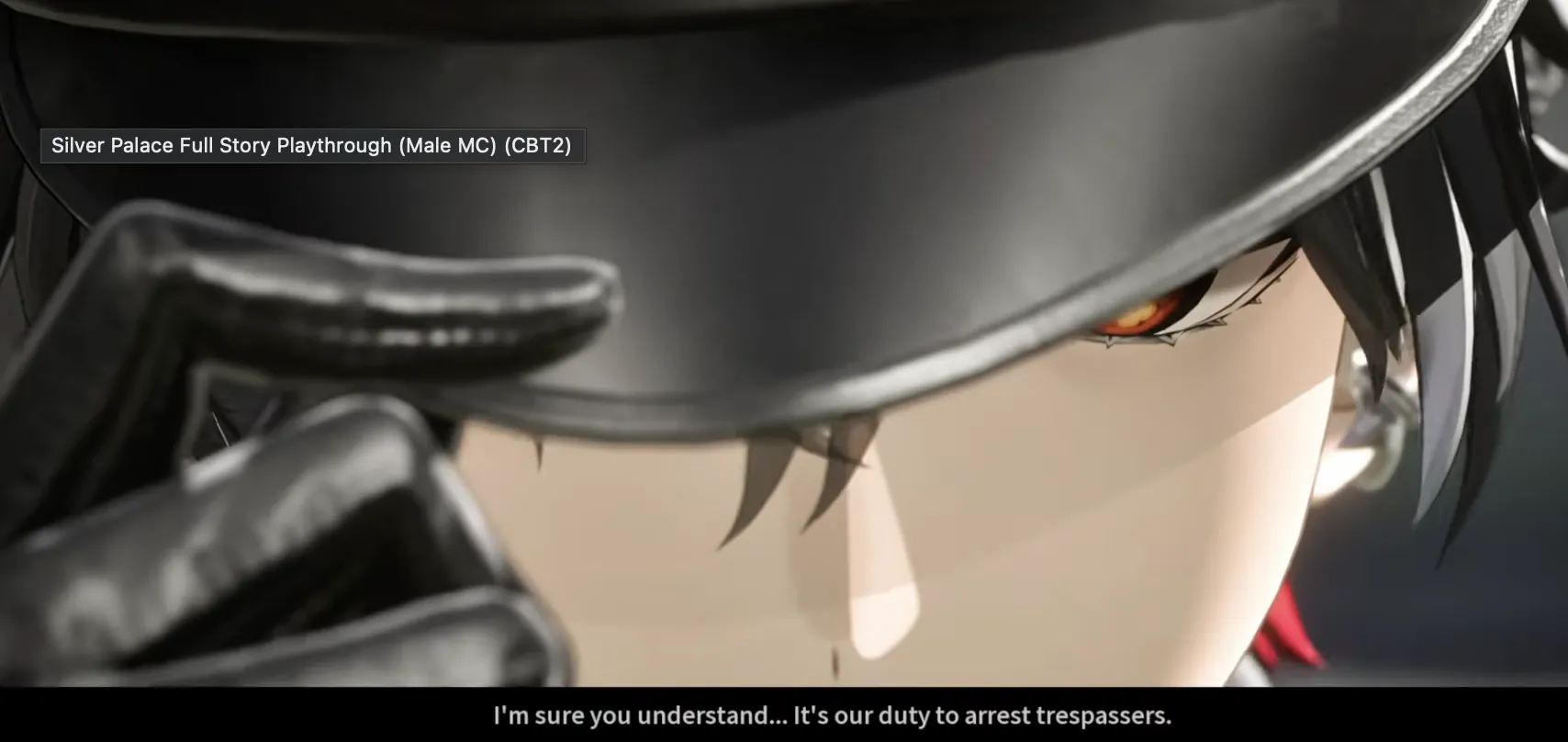
Silver Palace introduces Superintendent Rex in the worst possible order. You meet him standing over a corpse he has just taken away from you, and everything afterward arrives pre-framed. By the time the beta gets around to showing you why the Navy sent him into the River Constabulary at all, you have already spent hours filing him as the man who blocks the investigation, and the story never doubles back to correct you.
Follow him through the beta in order, watching what he does rather than what he prevents, and a different man assembles out of exactly the same scenes. He is not a hardliner who thaws once you prove yourself. He is stranger and far more consistent than that: the one officer in Silvernia who applies the same rule to a private detective, a bank, and the queen's cousin, and who spends the whole story being resented for it.

The man who takes the body
He arrives in Grimm's alley after the fact, and his opening line is an admission rather than an excuse: "I had it taken away." The body has gone back to the constabulary, he is overseeing the case from here, and anyone irrelevant to it should leave.
Listen to the reason he gives, though, because he will give the same one for the rest of the game. "This incident has attracted too much unwanted attention and is severely affecting our duties." Not you are interfering with me. Attention, and caseload. A superintendent worried about the press and the department's workload, which is a mundane thing to be worried about and an odd thing for a tyrant to lead with.
Then Lorin tries to cover for the Detective by passing him off as a civilian who happened to be nearby, and Rex declines to make a scene of it. What he asks for instead is a work report. He does not suspend his Chief Inspector, does not pull his badge, does not so much as raise his voice. He asks for paperwork and leaves, and Lorin, who has every reason to loathe him, smooths the moment over and offers to buy him a pint later.
None of that is exculpatory on a first pass. A body has been confiscated and a murder investigation has stalled, and the man responsible has said something bland about departmental duties. You have no particular reason to take him at his word yet. What the beta does next is hand you the reason, in a room where you are far too busy to notice it.
The room he was sent to fix
The order that put him there survives as a document, and it is four sentences long. The Royal Navy's Notice of Appointment states that a Superintendent "trained in military discipline" is being given supervisory authority over the River Constabulary, and it gives the reason without softening it: the force's "unsatisfactory rate of case resolution, which has fallen short of its founding mandate."
Two things in that notice shape everything Rex walks into. The Navy did not send reinforcements, it installed an officer above the existing chain of command, so the man arrives owing nothing to the people he now outranks. And the last sentence orders the commanding officer to have the notice "read aloud and circulated to all personnel upon receipt", which means every constable in the building heard, in the Navy's words, that they cannot close their cases. That is how you humiliate a department rather than help it, and it is why the floor's verdict on the Navy is that the help is making things worse.
Lorin cannot help openly, so he complains to nobody in particular that management always fusses over the small stuff while the real problems get swept under the rug, and mentions in passing that there is a leaky second-floor window on the east side and people sneaking into the evidence room, and nobody cares. The hint lands. The Detective goes in through the window.
What he is there for is a fragment of a charred left arm. What he walks past to reach it is the actual case against the River Constabulary.
Two constables, mid-conversation, unaware anyone is listening. One of them has been handed the werewolf that mauled the Queen's coronation parade and does not know what to do with it. The other tells him, bored, that there is nothing to worry about: run it through the process, call it an accident, and it is done. "Same as always."
Same as always. Not a bribe, not a conspiracy, nothing so dramatic. A standing habit of closing violent deaths as accidents because that is how the paperwork moves. Further into the building, two more constables agree it is best to stay well clear of noble affairs. On the way out, one of them needles another about having plenty of time for idle chatter and none for patrols. And when the Navy comes up, the verdict from the floor is that the Navy only sent help because the crime rate is still through the roof, and that the help is making things worse, and anyway they are not knights.
Read those exchanges together and Rex stops being a man imposed on a working department. He is the response to a department that writes off killings as accidents on principle, steers away from anything touching a noble, skips its patrols, treats an unsecured evidence room as somebody else's problem, and blames its own clearance rate on not being knights. The faction lore already lays out the structural version of this, an agency founded by the Navy, ordered into being by the Crown, and funded by the United Mining Industry, which is to say by three of the largest players in the scramble it exists to police. This is the same rot at conversational volume.
The staging is what makes it slip past. The break-in is framed as a caper, you are the one committing it, and the department's confession is background chatter you are trying not to be caught by. The beta tells you exactly why Rex exists at the one moment you have every incentive not to listen.
What he does when he loses
He catches you on the way out, and the fight that follows is where the antagonist reading quietly falls apart.
Start with what he brings to it. Rex commands lightning and chooses to fight a man committing a felony with a truncheon. His Composite Club is a pair of police batons that fold out into nunchucks, standard constabulary equipment and not a killing tool, the same design logic behind Lorin's electric gloves being set to non-lethal voltage. Two officers, two deliberately sublethal weapons, in a cast where most people carry a blade or a gun.
Then watch him handle the dogs. He sets Chalky on the Detective and calls Radar in to attack, and then, mid-fight, pulls one back: "Back off. Do behave yourself." He is correcting an animal's manners while losing.
And he does lose, and this is the part that never survives into a summary. He ends the fight himself, on his own terms, with "Let's leave it at that." Then he gives the man who just beat him a note on his loadout: "You're strong, but your heavy weapon is holding you back. A nimble combat style would suit you more."
Sit with how little sense that makes for the character everyone thinks he is. He does not call the reinforcements he certainly has. He does not charge the Detective with the burglary he personally witnessed and could prove. He never raises it again for the rest of the beta. He offers coaching. Seconds later a constable runs up to report that the werewolf from the float attack has escaped, that the stabilizer failed and it went berserk, and Rex answers in two words: "Lead the way." The arrest evaporates mid-sentence in favour of an actual emergency.
Ashley, shaken, asks the question the writing wants you to sit with: do you think he might come after you? He does not. He never mentions it again.
Then he bends the knee
He is not a saint, and the beta is careful to prove it about ninety minutes later.
Cynthia II of House Luna walks into the constabulary, demands to see Rex, and announces that everybody is to attend to her business at once. Lorin's account of the aftermath is precise and a little delighted: the superintendent came "within a whisker from blowing his top," and swallowed it, because the client was not someone the force could afford to anger. The case then lands on Lorin, as these things do.
The Detective's reaction is the sharpest line anyone gets about Rex all game. "Who are they that even Rex must bend the knee?"
The answer is the queen's young cousin, technically first in line to the throne, and the man who insists the law knows no compromise finds out exactly where his compromise is. That is worth naming rather than explaining away. His incorruptibility runs as far as the aristocracy and stops. It is the same fault line the Constabulary was built along, and he is standing on it like everyone else.
The suspect he was right about, and the one thing he got wrong
Howard Williams' fresh grave is robbed overnight, and the two eyewitness descriptions are a brown-haired woman in a white coat and a silver-haired man in a distinctive top hat, which is Firtho and the Detective to the letter. Rex bars them from the Cathedral of Illumination and tells them what he intends to do about it: "I advise you two to stay on your best behavior. Once we've all the evidence we need, we'll be coming for you."
Read that clause slowly, because it is the opposite of the line it sounds like. He is standing in front of two people he could plausibly detain on the spot, with witness testimony that matches them exactly, describing what will happen when he has evidence. And within the same conversation the Detective admits, out loud, that they did dig up the grave and did see the corpse. Rex's suspicion is not paranoia. It is the correct inference from everything available to him.
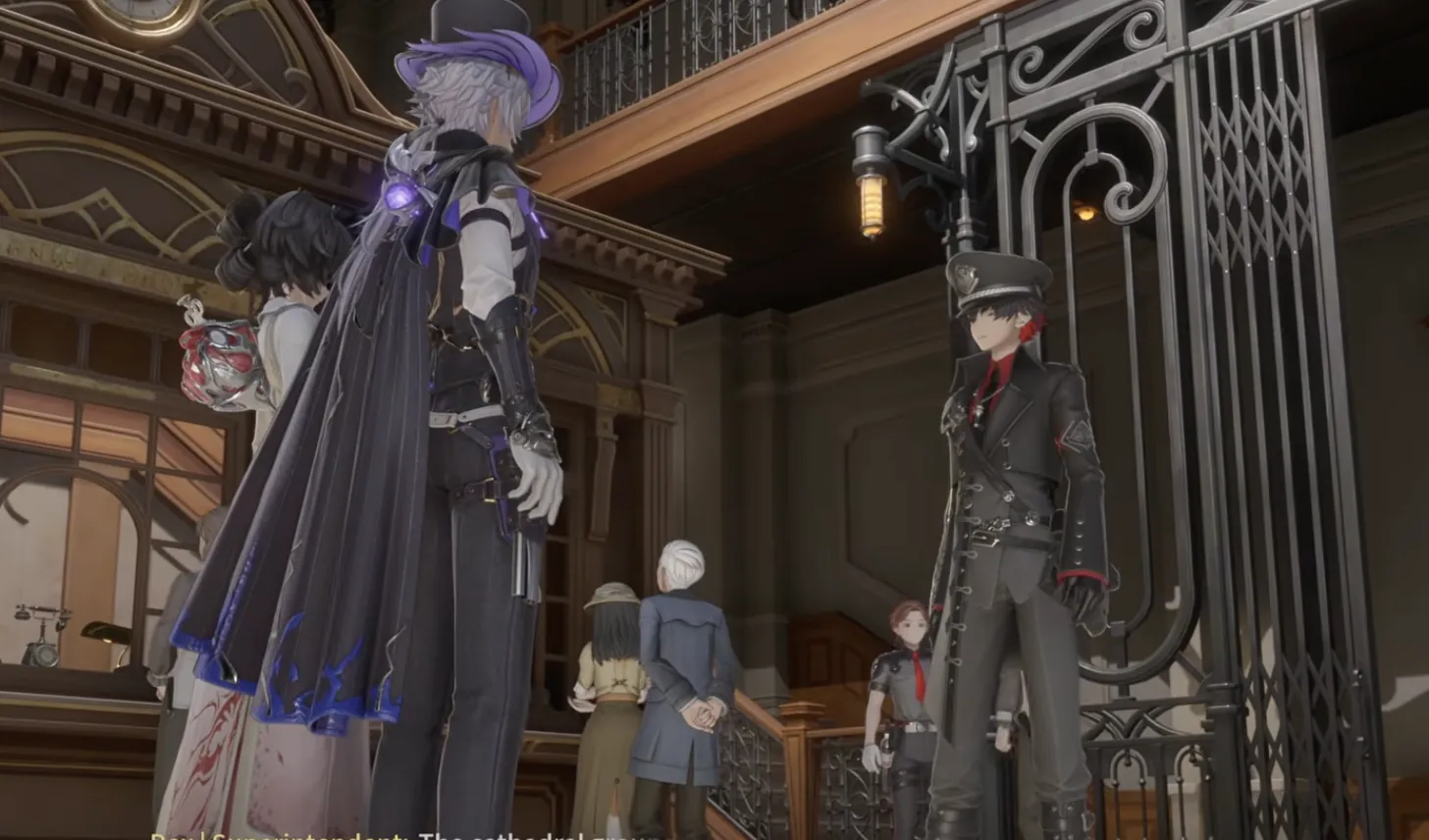
He is also, on the specific charge, wrong. The body was taken by somebody else entirely, and the grave-robbing theory is the only thing in the whole beta that Rex gets wrong about the Detective.
What he is doing here, Firtho and the Detective diagnose correctly the moment he walks off. Firtho, who says she knows Rex well enough to predict him, is certain he would never have lent them a hand in the first place. The Detective is more specific: "Rex has never been one to trust a lone detective. I should have known he'd refuse."
That is a doctrine, and it is not even his own. The Constabulary's standing rule, the one Lorin invokes to force the entire assistant interview sequence and put Ashley in the office to begin with, is that cases require a team of two and the Detective may not work one alone. Rex's objection to an unaccompanied private investigator inserting himself into a homicide is departmental policy, applied by the one man in the building who applies policy. Lorin waives it with a nod and a nickname. Rex does not, and the story reads that difference as villainy for most of its length.
There is one more thing in that evidence room worth mentioning here, mostly because it is funny and still tells you something. Among the unsorted files the Detective picks through is a constable's notebook holding a composite sketch of a suspect, and his read on it is that it looks like a minimalist version of Rex. Beside it sits a K-9 trainer's notebook whose entries run to kissing the dog on the nose, noting it has a warm belly, and wanting to take it home. Two gag items in a discarded heap, and between them the rank and file's honest opinion of their superintendent and of his dogs.
The apology nobody asked for
The Williams case ends badly and in public, and Rex does the thing his own philosophy says he cannot.
He clears the Detective without being argued into it. "A sorry state of affairs, detective. I no longer suspect you of stealing the body. I understand that this case did not take the path you had hoped for, but you have done all in your power. We failed to prevent these matters of the supernatural, and that is our burden to carry." Note who we is. He has just absorbed an institutional failure he had no hand in causing, on behalf of a department that would have closed the file as an accident.
Then the Detective needles him a little. So you truly believe in vampires now, Rex.
"I thought I did, but now I'm not so sure. While such stories have dominated the newspapers in recent days, none has so much as witnessed this vampire."
This is a man whose passive skill carries the flavour line "The boundary of light and shadow allows no ambiguity," saying plainly that he held a belief, looked at the evidence, and no longer holds it. It happens well before the arrest that supposedly wins him over. Nobody had to convert him. He was already revising.
"And why must she be in police custody?"
Everything above is groundwork for one exchange outside the Royal Bank, and it is the scene that should replace "obstacle who eventually relents" as the shorthand for this character.
Ashley, plainly dressed, has just talked one of the waiting investors out of his newspaper, the one carrying the photograph of the Rogue's wax seal that eventually cracks the case. A bank functionary decides she is beneath the clientele, calls her a gravel-kin whelp bothering their client, and instructs the nearest constables to take her into custody, with the immortal encouragement "Hey, look alive. You're police. So, start policing, will you?"
Rex walks into the middle of it. Told to put her in custody, he asks why. Told she is a public nuisance, he answers with the statute: by law it is vandalism, unlicensed construction, advertising and the like that fall under public nuisance, and he has not seen her do any of it. Then he turns the complaint around on the man who made it, for wasting police time with his nonsense.
Ashley thanks him by name.
Nothing about him has changed between the alley and this pavement. It is the same rigidity, the same refusal to bend a rule to accommodate whoever happens to be in front of him, pointed for once at somebody with money. That is the whole trick of the character, and the beta has been setting it up for hours: the trait that made him an antagonist is the trait that makes him unbuyable. He cannot be talked into arresting a poor girl for the same reason he could not be talked into letting a civilian near a corpse.
Hold that against what happens after Dr. Romme is shot and suspicion lands on Ashley in earnest. It is Lorin, the warm one, the one who waves off his own rank and calls the Detective an old friend, who says: "Given the situation, I have no faith in your innocence, Ashley. I'm taking you in." And it is the Detective who has to stop him, first with "The police hold the burden of proof. Unless you have evidence, she stays," and then, when Lorin insists she is suspicious enough, with "suspicion is not evidence."
The by-the-book fanatic protected her by quoting a statute. The sympathetic Chief Inspector tried to jail her on a feeling. Neither man is out of character in that moment, which is precisely why the pairing is there.
The bribe he overheard
The Boulden arrest gets reported as the moment Rex comes around. It is more specific and more revealing than that.
By the time the Detective reaches the vault, Rex has already started cooperating without being asked. He has told Ashley outright that the Constabulary knows the Rogue is targeting the Royal Bank, that they are taking him in this time, and that if she has any leads she should bring them at once, because he has men on standby. That is intelligence-sharing with a private detective's assistant, the exact arrangement he spent half the game refusing, offered before anyone has proved anything to him. He still shuts her out when she reads over his shoulder, because the files are confidential and both things are true at once.
Then Daniel Boulden, caught in his own vault, brags that he has sent the police away and starts bidding. Half of the night's takings. Then all of it. "Name your price. No matter the amount, I'm sure we can come to an agreement."
"I just need one thing."
"Name it. Whatever it is."
"You. I'm taking you in."
Rex was close enough to hear every word of it, and his first remark to the Detective afterward is not about the arrest at all: "Don't be fooled by the glib tongue of a criminal, detective. You made the correct choice." Then, to Boulden, the charge itself, because smuggling Silverium goods is a major offense and Boulden will pay for his crime.
That is the conversion, and it has nothing to do with gratitude for an assist. Rex had written the Detective off as an unaccountable freelancer, watched him get offered a fortune with no witnesses he was aware of, and watched him refuse. Incorruptibility is the only test Rex ever administers, on himself as much as anyone, and it is the only evidence he needed.
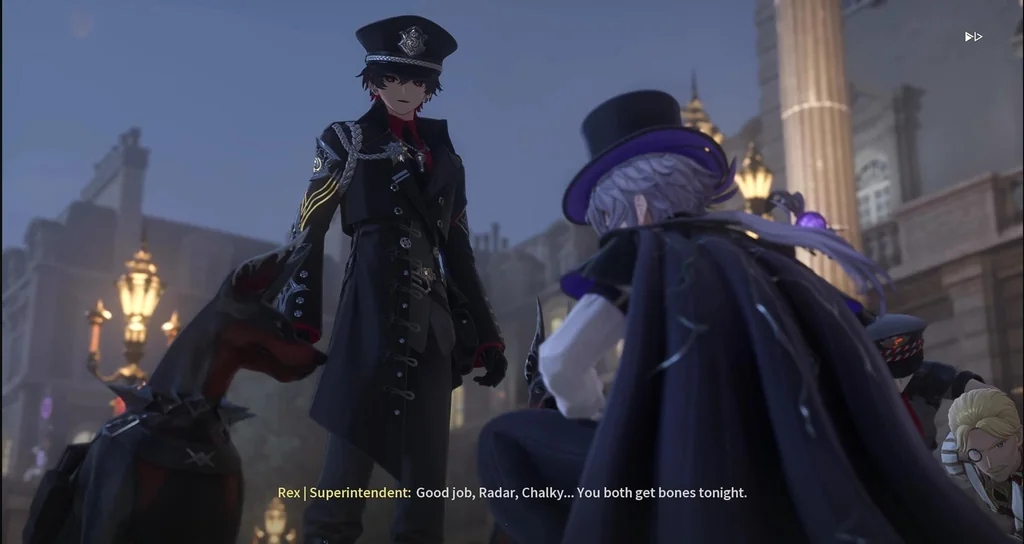
The thanks he offers is institutional, as you would expect by now: "Detective, I thank you on behalf of the River Constabulary." And then, in the very next breath, to the two Dobermans: "Good job, Radar, Chalky. You both get bones tonight."
What his kit had already told you
His own skill list has been quietly agreeing with all of this the whole time, which is easy to miss when you read it as a build rather than as a description of a person.
His title is The Scales of Black and White, and scales are not a verdict. They are what you reach for when you do not yet know which way a thing weighs, and they only mean anything if you will accept either answer. His stated philosophy insists that right and wrong admit no grey. His Skill is called Adaptive Rule, and it escalates in stages: Dual Truncheons opens, Extended Truncheon follows when the situation calls for more, and Nunchucks Law only arrives once his Volt Charge is full. Its flavour line is "Every brand of evil needs its own flavour of justice." Proportional response, written into the mechanics of a man who claims not to believe in gradations.
The Psyches keep the same tension. Naval Governance turns his chain of command into a stat line. Darkened White concedes in its own name that the white gets darkened. And the game files its verdict where players rarely look: his Identity is Hero, and his skills level on Hero's Instinct, Hero's Insight, Hero's Challenge and Hero's Legacy. Whatever the story does with him next, the data has already picked a side. The Fulmen kit breakdown has the numbers if you want them.
Verdict: you met him before you met his department
The man who assembles out of all this is not a tyrant learning humility, and he is not a good cop with a bad manner. He is something the setting has almost no other examples of: someone who treats the rules as binding on himself.
That single trait explains every scene he is in, including the ones that look like malice. It is why a civilian cannot approach a corpse and why a bank cannot have a girl arrested, why his Chief Inspector gets a work report instead of a reprimand, why a burglary he witnessed never becomes a charge, why he concedes a fight rather than escalate it, why he hands back a belief once the evidence stops supporting it, and why the only thing that ever actually moves him is a royal name, which is the one compromise the institution was built with and he inherited rather than chose. His blind spot is real and it is narrow: he cannot tell an honest freelancer from a corrupt one until he watches the man turn down money, because that is the only measure he has.
The beta spends three acts letting you assume the Navy sent a bully to a department that deserved better. It spends ninety seconds in an unsecured evidence room showing you what the Navy was actually looking at, and it lets two bored constables say it out loud instead of having anyone explain it. Rex never gets a redemption arc because there was never anything to redeem. You just met him first.
FAQ
Who is Rex in Silver Palace, really?
He is the superintendent the Navy posts to oversee the River Constabulary, and the beta's dialogue reads him as an officer who treats the rules as binding on himself rather than as an antagonist. He obstructs the Detective on procedural grounds, works from real evidence each time, drops the one suspicion that does not hold up, and is the only character in the game who refuses a wealthy man's demand to arrest a poor one. The game files his Identity as Hero.
Why does Rex keep blocking the Detective?
Because of a doctrine rather than a grudge, and not even his own doctrine. The Detective names it himself: "Rex has never been one to trust a lone detective." The Constabulary's own standing rule is that cases require a team of two, which is why Ashley gets hired at all. Rex applies that rule and Lorin waives it, and that is the entire difference between them.
Is Rex a villain in Silver Palace?
No, and the beta works fairly hard to show it. He fights with non-lethal police batons, calls his dog off mid-fight, ends a duel he is losing rather than escalate, advises the Detective on his weapon choice immediately afterward, abandons the arrest to deal with a berserk werewolf, never charges the Detective for a burglary he witnessed, and later clears him as a suspect unprompted.
Why was Rex appointed over the River Constabulary?
The Royal Navy's Notice of Appointment cites the constabulary's "unsatisfactory rate of case resolution, which has fallen short of its founding mandate." It installs a Superintendent trained in military discipline above the existing chain of command rather than adding officers to it, and it orders the notice read aloud to all personnel on receipt, so the whole department heard the reason it was being supervised.
What is the evidence room scene actually showing you?
While stealing a piece of Grimm's corpse, the Detective overhears two constables agree to write up the werewolf killing from the coronation parade as an accident, "same as always." Others in the building talk about avoiding cases that touch nobles and about skipping patrols. It is the clearest look the beta gives at why the Navy intervened, and it happens in the room Rex is being unreasonable about guarding.
Does Rex ever help Ashley?
Yes, well before he has any reason to. Outside the Royal Bank a bank employee dismisses her as gravel kin and orders the police to take her into custody as a public nuisance. Rex asks why, recites the legal definition of public nuisance, states that he has seen her do none of it, and tells the complainant he is wasting police time. Ashley thanks him by name.
Why does Rex finally respect the Detective?
Not for helping with the arrest. Rex is within earshot when Daniel Boulden offers the Detective half and then all of the night's takings to look the other way, and hears the Detective answer "You. I'm taking you in." His first words afterward are "You made the correct choice." Refusing money is the only test Rex ever applies.
What are Radar and Chalky?
Rex's two Doberman police dogs, summoned by his Ultimate, Thunderous Judgement, and at his side throughout the story, where he calls them by name mid-fight and pulls one back for overcommitting. Immediately after thanking the Detective on behalf of the River Constabulary, he tells them, "Good job, Radar, Chalky. You both get bones tonight."
Does anything outrank the law for Rex?
Rank does. When Cynthia II of House Luna demands the Constabulary drop everything for her, Lorin reports that the superintendent came "within a whisker from blowing his top" and swallowed it, because the client was not someone the force could afford to anger. The Detective's reaction is the telling one: "Who are they that even Rex must bend the knee?"
Know someone tracking Silver Palace? Send them this.
About the Author
Silver Palace Meta Team
Silver Palace Meta Team
We're dedicated to providing comprehensive coverage of Silver Palace news, updates, and community insights.