Silver Palace Name Origins: Grimm, Rex, and Firtho
The first pass at Silver Palace's name origins covered Hugin and Munin, Gratia, Argos, Alf, and Red Rose. That piece did not run out of characters because the roster ran out of references. It ran out of room. Three more names hold up under the same scrutiny: Grimm, Rex, and Firtho. None of them borrow a name outright the way Hugin and Munin do. What they borrow instead is a role, and in one case, a real editorial correction that the game's own writing seems to understand better than most retellings do.
Grimm: The Chronicler, Not the Author
Get the Brothers Grimm reference right before you use it, because most people get it wrong. Jacob and Wilhelm Grimm did not invent Cinderella, Snow White, or Rapunzel. They collected them. Children's and Household Tales, first published in 1812, is a compilation of oral folklore the brothers gathered from local storytellers and reworked for print across several editions. The stories predate the book by centuries in some cases. Cinderella alone has versions traced back to ancient Greece and a nearly identical account written down in ninth-century China.
So the Grimm name is not "author." It is "recorder." A chronicler.
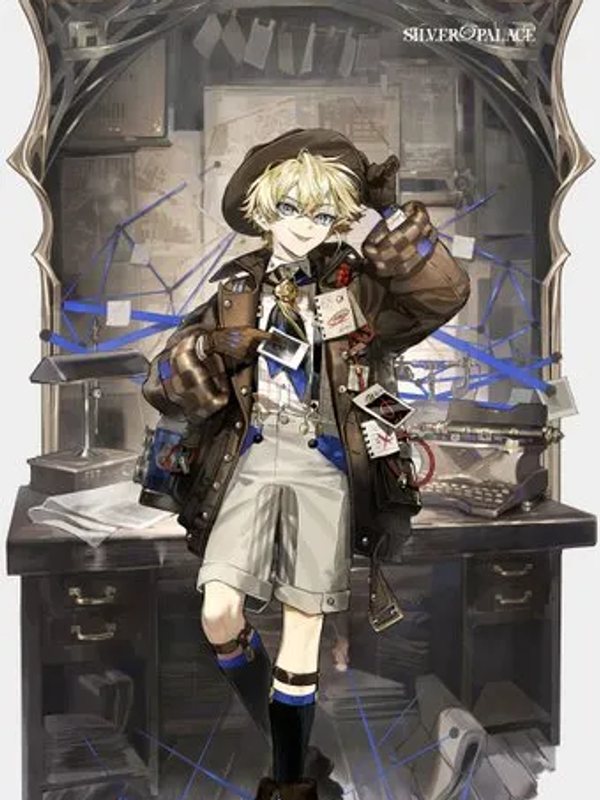
That word is not a stretch here. Grimm's own character copy calls him exactly that: "A chronicler of modern society, he never hesitates to risk danger when opportunity knocks. Whether denouncing scandals or giving a voice to the sadly departed..." He is a journalist, "Silver-tongued Headliner," born into the lower rungs of Silvernia and sharp enough to talk his way past them. He does not write the scandal into existence. He finds it already happening and puts it on the page, the same relationship the real Grimm brothers had to the folk stories that came through their door.
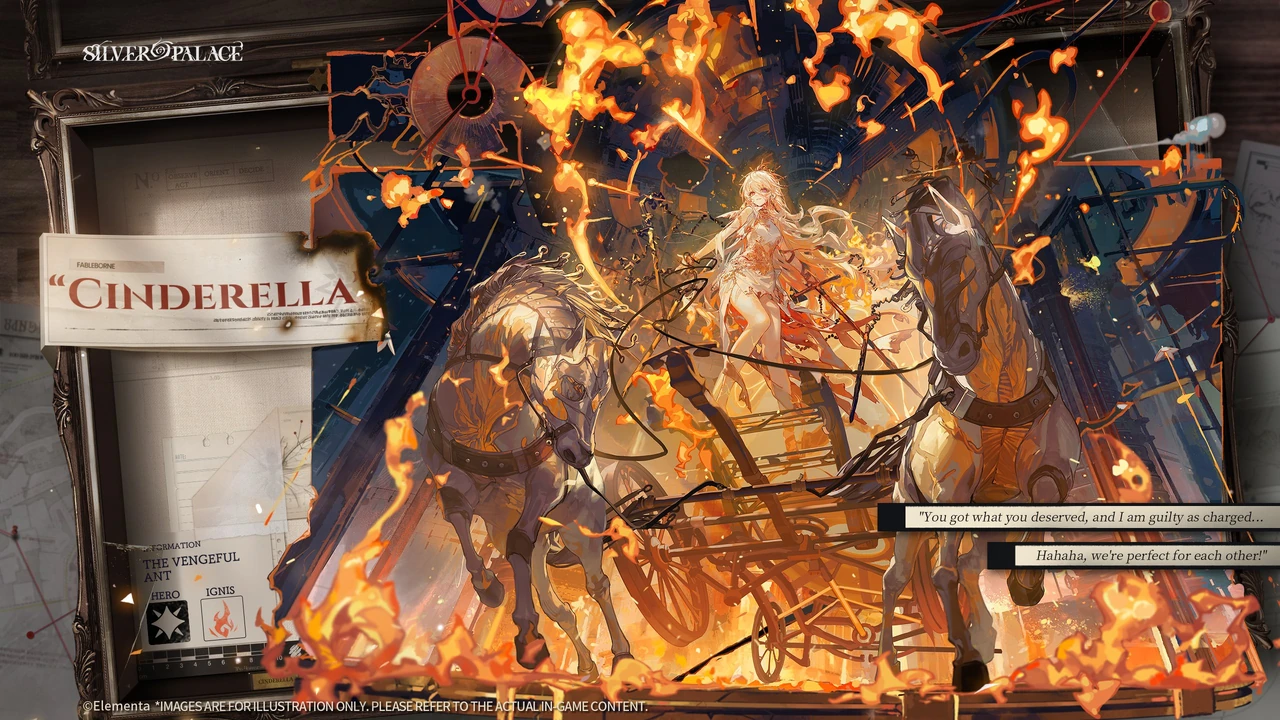
The timing sharpens the parallel. Silver Palace's current story arc runs the Cinderellas case, and Cinderella is the fairytale the Brothers Grimm are most associated with in the popular imagination, despite having no hand in creating it. A journalist named after the most famous recorder of Cinderella, revealed as a "Silver-tongued Headliner" and turning up throughout Silvernia wherever that same investigation surfaces, is not a coincidence worth ignoring. Grimm is not writing the Cinderella story. He is documenting it as it happens around him, which is precisely what a chronicler does. For the trailer moment that shows this chronicler role in action, before any of it was confirmed, see the trailer symbol theory breaking down the alley scene where he photographs Cinderella and the Detective.
Rex: The Queen of Hearts With Two More Heads
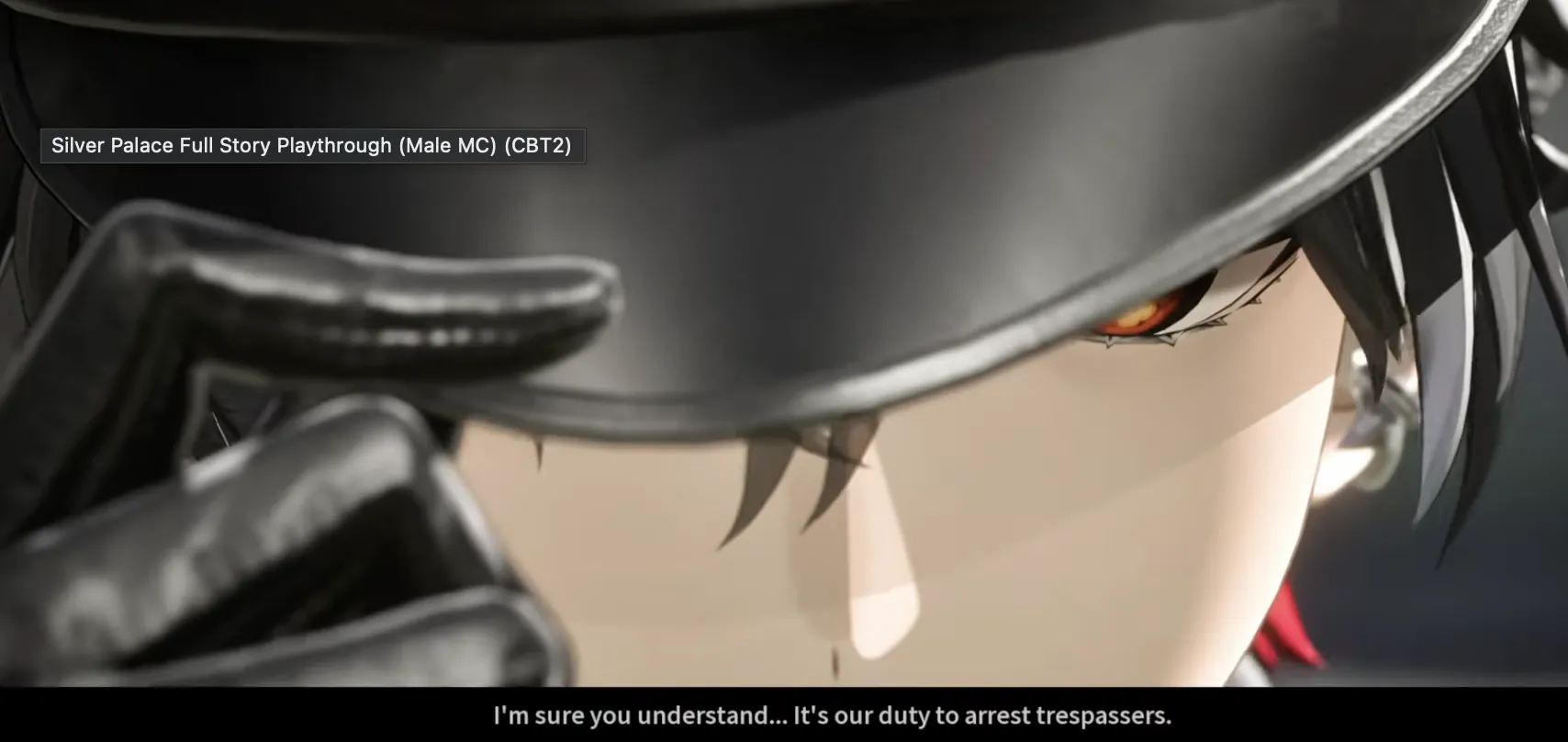
Rex's tie to Alice in Wonderland's Queen of Hearts is not fan reading. It is confirmed in his own character material, and once you know it, the fit is almost too neat. The Queen of Hearts runs Wonderland on absolute law with no capacity for mercy, famous for a single sentence applied to every crime: off with their heads. Rex's stated philosophy is the same instinct without the theatrics: "Enforcers of the law must show no leniency to maintain its authority." Right and wrong, black and white. In his eyes, evil has no shades of grey. That is a tyrant's justice system running through a superintendent's badge instead of a playing-card crown.
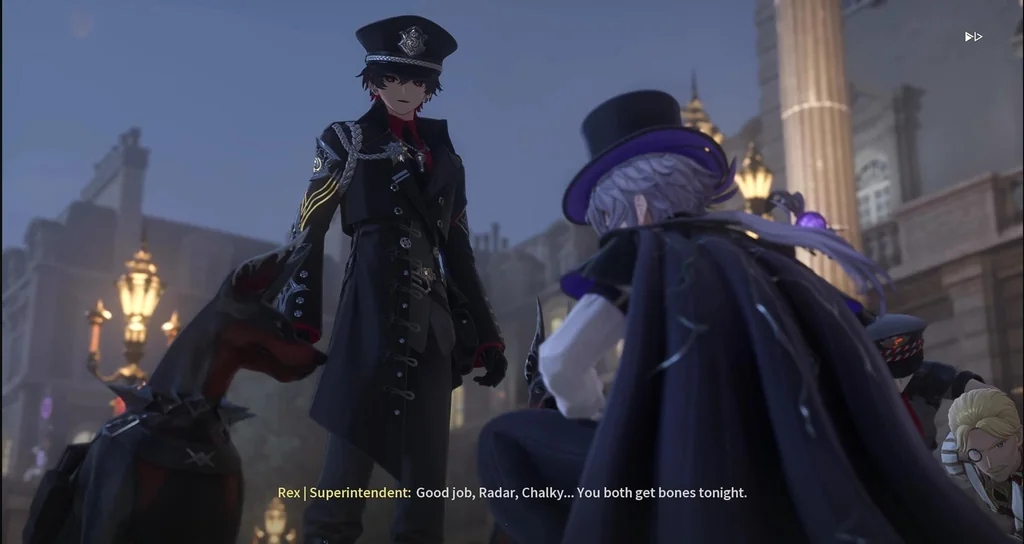
Layer a second reference on top and it does not fight the first one. It adds to it. Rex's confirmed Ultimate, "Thunderous Judgement," part of his Fulmen/Resonance DPS kit, summons his two Doberman police dogs, Radar and Chalky, before the lightning strike lands. Three figures enforcing one sentence: Rex and his two dogs. That is the shape of Cerberus, the three-headed hound that guards the threshold of the underworld in Greek myth and lets nothing cross without judgment. A superintendent who polices the border between the law-abiding River Constabulary and everyone he decides does not belong there, backed by two more sets of teeth, reads like a modern badge-wearing Cerberus more than it reads like coincidence.
Both references land the same theme from different mythologies: absolute, unbending enforcement, no appeals process. The Alice connection is the one Elementa has actually confirmed. The Cerberus reading is community-level pattern-matching on top of it, not an official claim, but the dog count alone makes it hard to un-see.
Firtho: The Detective's Watson, Maybe
Firtho does not carry a name that maps onto anything in a myth index. What she carries is a job description that lines up with a specific literary partnership: the detective and the doctor who patches up what the detective's methods leave behind.
Her own character page calls her "a reliable examiner, a doctor, and a close friend who lives alongside death day after day," and her earlier title line goes further: "Death, on the other hand, has been a truer friend." In the Dichotomy Beta story she is the coroner behind the corner clinic, the Detective's childhood friend, nicknamed Miss Mortis for a childhood spent watching autopsies. She brews the stabilizer that holds off the Detective's nightmares. She runs the forensics, the chemical analysis, the anatomy work, everything the Detective needs after a case has already gone sideways.
That is the Watson division of labor almost exactly. Arthur Conan Doyle's Dr. John Watson is a trained physician who tags along on Holmes's cases, tends the wounded, and grounds the detective's leaps of deduction in medical fact. Firtho is not narrating anyone's adventures, so the parallel is a role match rather than a name match, unlike Hugin and Munin where the etymology does the work by itself. But the shape is exact: the detective works the mystery, the doctor works the body, and one relies on the other to close the case. Her own locked-room vampire case at Williams Manor, where she injects herself with a nerve agent and fakes her own death to expose a fraud, is the kind of hands-on, science-first problem solving Watson built a career on.
Treat this one as a reading, not a confirmed reference. "Firtho" has no obvious etymology pointing at Watson the way "Alf" points at elf. What lines up is everything around the name: the medical expertise, the closeness to the Detective, the role of grounding deduction in physical evidence.
What Lorin's Name Doesn't Tell You (Yet)
Not every name on the roster has cracked yet, and Lorin is the clearest example. The best guess circulating so far links "Lorin" to "lantern," by way of Stingy Jack, the Irish folk figure behind the jack-o'-lantern legend, who tricked the devil and ended up wandering the earth with a burning coal in a hollowed turnip. Lorin does carry a lantern, and his story does not paint him as a straightforward good guy. It is a thin thread, though: a sound-alike name and a matching prop, nothing close to the etymological lock Hugin and Munin have. Filed as an open question, not a section that needs its own conclusion.
The Pattern Holds
Across both name-origins pieces, one thing stays consistent. Silver Palace does not attach a myth to a character for decoration. Hugin and Munin are ravens because the Detectives gather knowledge the way ravens do. Argos is a hundred-eyed watchman because bartenders see and hear everything. Grimm chronicles a Cinderella case under a name that means "recorder of Cinderella." Rex enforces absolute law under two mythologies that both describe absolute, mercy-free judgment. The name tells you the job before the story does.
FAQ
Is Grimm actually related to the Brothers Grimm?
The connection is thematic rather than a stated in-game confirmation: Grimm's own description calls him "a chronicler of modern society," which mirrors the real Brothers Grimm's role as recorders of existing folklore, not the authors of it. The Cinderellas case he is investigating strengthens the parallel, since Cinderella is the story most associated with the Grimm name.
What is Rex's Cerberus connection?
Rex's confirmed lore ties him to the Queen of Hearts from Alice in Wonderland, a ruler who enforces absolute law with no mercy. Community readers have also noted that his confirmed Ultimate summons his two Doberman police dogs, Radar and Chalky, alongside him, forming a three-figure enforcement unit that echoes Cerberus, the three-headed guardian of the underworld in Greek myth. The Alice link is confirmed; the Cerberus reading is fan theory.
Is Firtho based on Sherlock Holmes' Dr. Watson?
It is a theory built on role rather than name etymology. Firtho is a doctor and forensics specialist who works alongside the Detective, tending to the medical and scientific side of cases the way Dr. Watson supports Sherlock Holmes. There is no confirmed naming reference, unlike Alf or Hugin and Munin.
Does Silver Palace confirm every one of these name origins?
No. Hugin, Munin, Alf, and Rex's Queen of Hearts tie are the clearest confirmed references across the roster. Grimm's chronicler parallel and Firtho's Watson-style role read as strong, deliberate design choices but are not stated outright by Elementa. The Cerberus reading for Rex and the lantern guess for Lorin are community theory, included here because the evidence is worth knowing, not because they are confirmed.
Know someone tracking Silver Palace? Send them this.
About the Author
Silver Palace Meta Team
Silver Palace Meta Team
We're dedicated to providing comprehensive coverage of Silver Palace news, updates, and community insights.