Case Files
案件档案
Every named investigation in Silvernia and what is pinned to its evidence board, from the burned bodies nobody could identify to the scholar who came back from the dead.
Silvernia generates more unexplained death than its constabulary can process, and the Detective picks up the residue. Each investigation arrives as a file with a name on it, and each one that goes anywhere gets a board: clue slots strung along a chain of reasoning, filled from a repository of everything you have gathered so far.
This page is the case index. Ten of them, nine with boards, 82 exhibits between them, each one written out with what it is and what it tells you. For how the campaign divides itself into acts and scenes instead, read Major Cases. For the mechanics of gathering the clues in the first place, read the investigation and deduction guide.
Quick Answer
Ten named cases, nine with evidence boards, 82 exhibits in total. Six are Main Cases inside the campaign, three are Curious Cases that branch to more than one ending, and one is a personal favour that turns into the best-kept secret in the constabulary.
| Case | What it turns on | Exhibits | Type |
|---|---|---|---|
| The Nameless Ashes Case | Bodies burned past identification, and no leads | No board | Main Case |
| The Stolen Silver Mystery | Coins gone from a locked safe, key never used | 7 | Main Case |
| Case of the Journalist's Death | The forensics stop matching the witnesses | 10 | Main Case |
| Theft at the Royal Bank | Evidence that points a little too neatly at one thief | 5 | Main Case |
| Case of the Rising Detective's Death | A hidden office, a great deal of blood, no body | 6 | Main Case |
| Cinderellas Case | A notebook, and a name with a plural on it | 12 | Main Case |
| Lorin's Troubles | Why the best brawler in the constabulary will not act | 5 | Character case |
| The Resurrection Enigma | A bedroom bolted from inside, and a corpse that got up | 21 | Curious Case |
| Legend of the Werehound | A monster rumour that turns out to be sold by the cup | 8 | Curious Case |
| Extraterrestrial Tales | Aliens over Four Crowns Street, and a burst pipe | 8 | Curious Case |
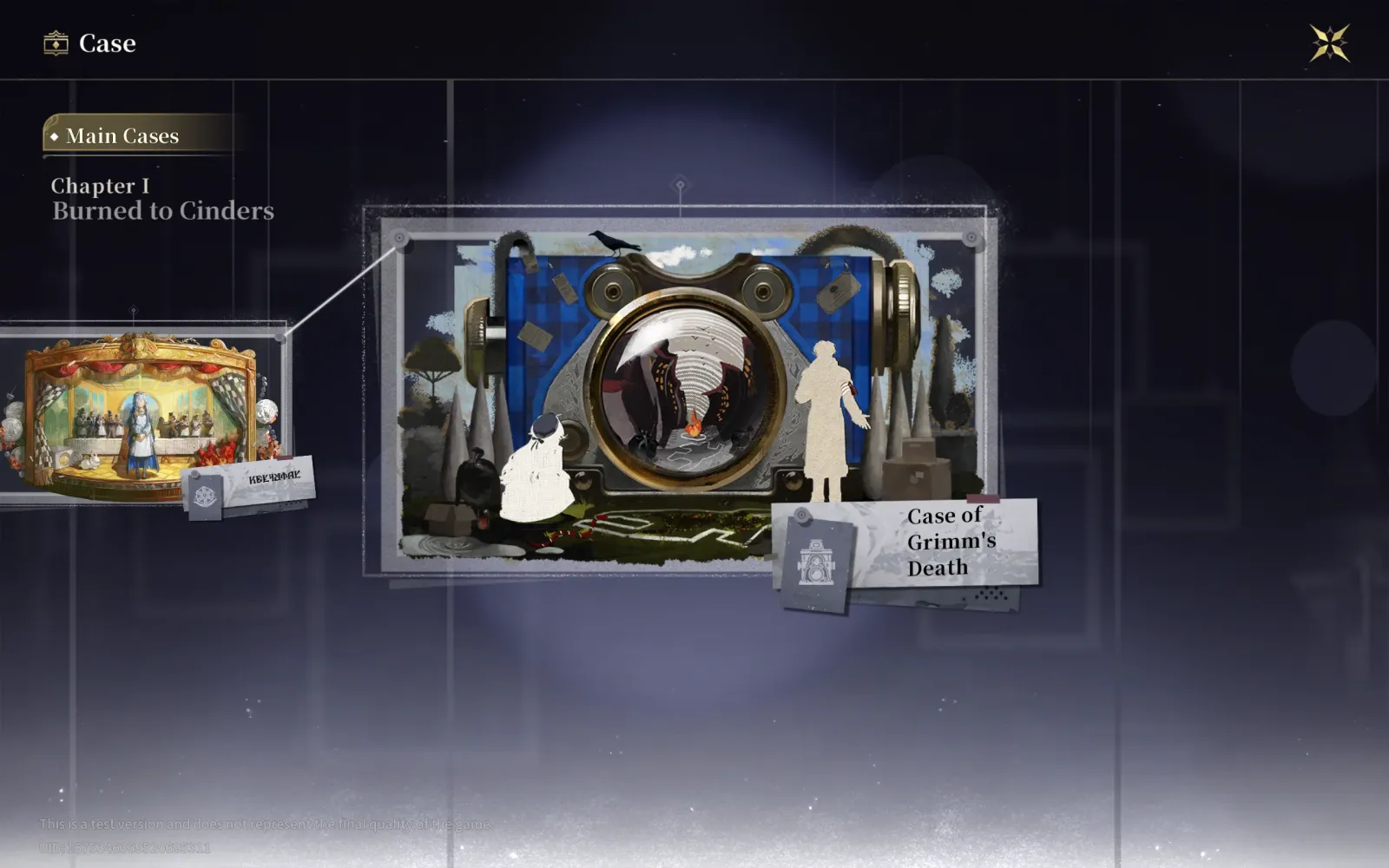
The game's own Case screen. Chapter I is Burned to Cinders, and the diorama on the right is the Case of Grimm's Death. Official Elementa beta footage.
How a case file works
Three things happen in every one of these, in order. You gather, by walking a scene and pulling clues off it. You examine, which is where forensics turns a charred body into a cause of death and an approximate age. Then you reason, on the board, by putting each clue into the slot the chain needs.
The board is the part that can go wrong. A slot only accepts the piece the chain is actually built on, so a plausible guess bounces and the chain stays open. In a Main Case there is one way through. In a Curious Case there is more than one conclusion you can reach and only one of them is true, which is what the Restart Deduction option exists for.
The boards below are laid out the way the game groups them. An exhibit is a lead, a piece of physical evidence, a testimony, a forensic result, a document, a person, a place, or a deduction you make yourself from two things that do not fit together.
The Nameless Ashes Case
Chief Inspector Lorin hands the Detective a file with a provisional name on it: several bodies burned to charred remains in a disused suburban factory. None of the victims can be identified, and the case has almost nothing to work from.
This is the case the main story is built around, and its emptiness is the point. The lack of leads is the hook everything else hangs on. Much later, the injuries on these victims turn out to match a needle recovered from the United Vermentum Works infirmary, which is what folds the whole thing into the Cinderellas Case.
The Stolen Silver Mystery
Not a crime scene but a riddle, posed by Ashley: a wealthy man's silver coins vanish from a locked safe, and the key was never used. Solving it means working out how something leaves a sealed room without the door ever opening.
The riddle is an allegory for the Silverium smuggling running through United Vermentum Works, and it is a precise one. The trick in the fable is the method the company uses to move material past its own security gates.
The case is also written as Mystery of the Stolen Silver and The Allegory of the Vanished Silver.
| Exhibit | Kind | What it shows |
|---|---|---|
| Rich Man | Lead | The owner of the coins. One of the three threads the board opens with. |
| Key | Lead | The safe key that was never turned, which is the detail that makes the theft look impossible. |
| Silver Coins | Lead | The missing stash itself. |
| Sacrificial Ant | The answer | Silver-eating ants carried the metal out of the safe and were burned afterwards so it could be recovered from their remains. A bleak image, and it doubles as a parallel to both the Cinderellas Case and Ashley's own history. |
| Lorin's Protection | What came of it | With Ashley named a suspect in the Rising Detective's Death, Lorin signals that he may be able to shield her. |
| Grimm's Report | What came of it | Grimm publishes an expose of how United Vermentum Works treats its workers and of the Silverium smuggling. Public anger forces Vorsch to answer for it. |
| Firtho's Remedy | What came of it | Firtho develops a treatment that lowers the concentration of Silverium in the body. It blunts the workers' symptoms and falls short of a cure. |
Case of the Journalist's Death
Grimm the journalist is found dead in an alley, burned past recognition. The forensic picture stops matching the witness accounts almost immediately, and the question turns from who killed him into whether the body is his at all.
The burning is staged. This is the case that sets up Grimm faking his own death, and the notebook he leaves behind is what opens the Cinderellas Case. It resolves in Act II, Scene III of the campaign, which Major Cases covers as story structure.
The case is also written as Case of Grimm's Death.
| Exhibit | Kind | What it shows |
|---|---|---|
| Witness's Testimony | Testimony | A badly shaken bystander describes seeing Grimm screaming in flames in the alley that afternoon. |
| A Charred Corpse | Physical evidence | A body carbonised past recognition, carrying none of the Purists' markings, coated in an unidentified substance with the texture of mud. |
| Grimm's Hat and Camera | Physical evidence | His two constant possessions, both destroyed. The film inside the camera was never exposed. |
| Reactor Residue | Physical evidence | Silverium leavings from Reactor use are on the ground, and no Reactor is anywhere at the scene. |
| Street Punkster's Testimony | Testimony | A punk arrested fleeing the scene insists he never saw a body, and describes an ugly confrontation with a noble lady in the alley instead. |
| One High-Heeled Shoe | Physical evidence | Dropped by the noble lady during the scuffle. An uncommon size, well worn and carefully maintained, carrying the same unknown substance found on the corpse. |
| Special Substance? | Physical evidence | The unidentified compound that appears on both the body and the shoe, which is what ties them together. |
| Forensics Data: Cause of Death | Forensics | Firtho's examination shows the victim was already dead before the fire. The burning was done to a corpse. |
| Forensics Data: Gender and Age | Forensics | The remains belong to a male of roughly thirty years. |
| Forensics Data: Fireproofing Agent | Forensics | The mystery substance is a fireproofing agent of water, thickener and slurry, and it can be applied to skin to protect against burns. |
Theft at the Royal Bank
A large quantity of antique silver coins goes missing from the Royal Bank. Everything at the scene points to the master thief known as the Rogue, and that is exactly the problem. The evidence is too tidy, and the details underneath it do not line up.
The theft is a frame. Bank investor Daniel Boulden used the Rogue's reputation as cover, and Boulden's connection to Vorsch is what opens the path into United Vermentum Works.
| Exhibit | Kind | What it shows |
|---|---|---|
| Rogue's Calling Card | Physical evidence | The card left at the scene. It carries an X wax seal, where the genuine Rogue letters already in police hands carry VI. That single mismatch is what exposes the frame. |
| Rogue Case File | Document | The constabulary's own standing file on the Rogue, used to compare the planted card against authentic material. |
Three further threads hang on this board with nothing published behind them: complaint letter against the railway company, armed maids and removal of unauthorised personnel. They are named here because the board is not complete without them, and left undescribed because guessing at the contents would be worse than the gap.
Case of the Rising Detective's Death
Behind a hidden door is a room papered with newspaper cuttings, the late rising detective's secret office. The blood and the decay make murder obvious. The killer, the motive and the missing body do not.
The room holds the original Cinderella Case board, and reading it reveals the rising detective as a contract killer working for United Vermentum Works, killed by one of the women he was sent after.
| Exhibit | Kind | What it shows |
|---|---|---|
| Bloodstained Floor | Physical evidence | A wide fan-shaped stain, enough blood loss to be fatal. The spray points to a severed carotid artery from a thrust with something very sharp. |
| Dagger Beneath the Cabinet | Physical evidence | A bloodied dagger left under the cabinet, decorated in a men's style, matching the one the rising detective carries in the newspaper clippings. |
| Signs of a Fight | Physical evidence | Furniture thrown out of place and blood across the walls. A violent struggle, not a clean killing. |
| Shabby Evidence Board | Document | A disorganised board headed Cinderella Case, hung with photographs of women in work attire. Most are crossed out with notes about disposed remains and silenced relatives. Four marked Escaped are corrected to incinerated with identities expunged. One charred portrait at the bottom is annotated as escaped, presumed burned, no body found. |
| Documents in the Safe | Document | Letters under the United Vermentum Works seal, running an argument back and forth over the price of sensitive information. A large cheque sits inside the final one. |
| Burned Photo | Physical evidence | A portrait blackened and blistered by fire, labelled as escaped, presumed burned to death, with no body recovered. |
Cinderellas Case
Grimm finds something far larger than he can survive publishing, and fakes his own death to get out from under it. What he leaves behind is a notebook, and the name he gave the thing he found. The plural is deliberate. There is more than one Cinderella.
This is the spine of the main story, and the board is the biggest in the campaign at twelve threads. It is where the Royal Bank theft, the doctor's murder, the rising detective and the Nameless Ashes victims all turn out to be the same operation running out of United Vermentum Works.
The case is also written as Cinderella Case.
| Exhibit | Kind | What it shows |
|---|---|---|
| Results of the Investigation Into the Business Magnate | What the investigation found | Royal Bank investor Daniel Boulden, who used the Rogue as a scapegoat to steal the bank's antique silver reserve and was caught doing it. Boulden was close to Vorsch, an executive at United Vermentum Works. |
| Results of the Investigation Into the Doctor | What the investigation found | Dr Romme of Skea Private Hospital, found while an assassin was hunting him and killed before he could be saved. He had been making repeated visits to United Vermentum Works to carry out health check-ups. |
| Results of the Investigation Into the Mysterious Man | What the investigation found | The rising detective, a hired blade for United Vermentum Works who hunted down factory girls who ran, until one of them turned his own weapon on him and got away. |
| The Allegory of the Vanished Silver | Lead | Ashley's riddle about the wealthy man's missing silver, recognised for what it is. Mapping the fable onto the company exposes the method. |
| Discrepancies in the Company Accounts | Document | A secretary at the United Mining Industry, running an investigation of her own, points out several inconsistencies in the books. |
| High-Purity Silverium | Document | Production records from Vorsch's office showing the company refining Silverium to 91 per cent on industrial Reactors. That is a weapons-grade purity the Crown forbids, and no civilian product needs it. |
| Raw Silverium | Lead | Security at the factory has tightened, and the raw Silverium going in no longer matches what comes back out. |
| Afflicted Worker | Person | A factory woman whose body has been broken down by years in a toxic workplace. |
| Silverium Injector | Physical evidence | An injector recovered from the company infirmary with no plausible medical use. Its needle shape matches the scars on the Nameless Ashes victims exactly, which is the join between the two cases. |
| UVW Infirmary | Location | The clinic the company opened for its sick workforce. Nobody treated there appears to recover. |
| Train | Physical evidence | Vorsch's men crated the women's bodies and loaded them onto trains leaving the city. |
| UVW Security Gate | Location | Everyone entering and leaving the factories is inspected, and the detectors sound an alarm on any Silverium at all. This is the constraint the smuggling method exists to defeat. |
Lorin's Troubles
Chief Inspector Lorin is struggling to deal with a gang of thugs disturbing the peace, which makes no sense. Handling thugs is the thing Lorin is best at. The case is not why he cannot manage it. The case is why he will not.
A character case, and a short one, but the answer is the best-kept secret in the constabulary. The gang's totem and the signature on their proudest piece of graffiti both point back at Lorin himself. The Silver Fist covers what that means.
| Exhibit | Kind | What it shows |
|---|---|---|
| Lorin's Wound | Physical evidence | A facial injury under a band-aid. The cut is too small for a werewolf and reads as a bruise taken while arresting a thug. |
| Citizen's Complaints | Document | A case file recording repeated resident complaints of disorder and vandalism by a local gang. A verbal warning was issued, the disturbances continued, and Lorin signed off on the follow-up personally. |
| Lorin's Weapon | Physical evidence | His favoured boxing glove, worn down by years of use. |
| Graffiti Wall | Physical evidence | Gang graffiti showing a faceless male figure, the hooligans' totem. The silhouette is recognisable, and the arm in a boxing glove especially so. |
| Graffiti Tag in Hideout | Physical evidence | The gang's most prized piece, signed Silverfist. The signature is oddly crooked, as though it was written with the wrong hand. |
The Resurrection Enigma
A doctor vanishes from his own clinic, a wound disappears from a body in a cemetery at night, and the word people reach for is resurrection. The largest board in the game at twenty-one threads, built around a bedroom bolted from the inside, a mask, and a corpse that may never have been one.
The one Curious Case the game has shown in full, which means it branches and it has more than one ending. Only one of them is the truth. Curious Deductions covers the endings and the Restart Deduction option in detail; what follows is the board itself.
| Exhibit | Kind | What it shows |
|---|---|---|
| Trail of Liquid | Physical evidence | Drag marks through spilled liquid on the clinic floor, running towards the doorway. |
| Loose Debris | Physical evidence | Damp, soft soil with moss through it, left on the clinic floor. |
| "Williams" | Document | A discarded letter naming someone surnamed Williams, a name that also appears in the cemetery at the Cathedral of Illumination. |
| Sidney's Testimony | Testimony | The maid Sidney reports a scream at three in the afternoon. Staff found the master bedroom bolted from inside until Master Boris picked the lock, revealing Howard's body. |
| Firtho's Testimony | Forensics | Firtho examines Howard's arm at her clinic and places death around noon. Rigor mortis had progressed normally, which rules out Vampirism. |
| Conflicting Accounts | Testimony | Asked to describe the expression on Howard's corpse, the servants and Master Boris each give a different answer. |
| Silverium Mask | Physical evidence | A mask from Howard's laboratory. The shelf holds space for seven and only six remain. |
| Masked Corpse | Physical evidence | This is what explains the conflicting accounts. A mask covered the body's face when it was found, and Howard's notes claim the mask lets the wearer become a vampire through a ritual. |
| Vampire Rites | Document | Per those notes, an ordinary person becomes a vampire within an hour by injecting the conversion drug and wearing the Silverium Mask. |
| Cause of Bruising | Forensics | Firtho doses herself with the anaesthetic and develops bruises like Howard's. The journal describes it as hiding the signs of life well enough to pass for a corpse. |
| Ownership of the Key | Lead | Howard and Baron Edgar both held keys to the main gate and the bedroom, and Master Boris can pick locks. |
| Boris's Interference | Testimony | Master Boris obstructs the investigation repeatedly, objecting to the intrusion into a recent family tragedy. |
| Another "Body" | Deduction | The corpse Firtho saw carried out of the manor may have been a living person in a deathlike sleep rather than a body at all. |
| White Markings Inside the Closet | Physical evidence | Tape residue inside the wardrobe, left by something held in place. Attempts to recreate it confirm nobody could have sealed themselves in without suffocating. |
| Used Syringe | Physical evidence | A syringe from the bedroom, emptied completely. It held either the Vampiric Serum or the specialised anaesthetic. |
| Reduced to Ashes | Physical evidence | The fireplace was used to burn a sizeable wardrobe. A letter opener was found among the ashes. |
| A Scream From Elsewhere | Deduction | Sidney heard a scream at three, and death occurred around noon, so the scream came from someone else. |
| Jekyll's Testimony | Testimony | Jekyll's schedule places him, Grant and a guard maid out buying supplies on the afternoon of the crime, which means the others both witnessed it and attended the funeral. |
| Familiar Bittersweet Scent | Physical evidence | An outfit the deceased often wore, cleaned thoroughly but styled differently from his burial clothes. Black residue in the leather grain carries a bittersweet smell, something like chocolate or liquorice, and recently encountered. |
| Firtho's Physical Condition | Forensics | The anaesthetic kept Firtho unconscious for over six hours, and her strength returned slowly enough that even simple movement was hard. |
| Alf's Apology | Physical evidence | Alf took Firtho's scalpel by accident while preparing roast chicken and baked her a cake to apologise. That is the bittersweet scent, and the thread that closes the board. |
Legend of the Werehound
Morgue Street is talking about a hound-like creature walking around in human clothes, and enough locals claim to have seen it that the rumour has momentum. The trail runs from a cheap pamphlet to a red drink to a gang warehouse.
The werehounds are made, not born, and the thing that makes them is sold over a counter. Botilin traces back to werewolf blood being moved out of North Felix Lane, which puts this alongside the metal-blooded rather than in folklore.
| Exhibit | Kind | What it shows |
|---|---|---|
| Detective's Encounter | What the investigation found | The Detective's own notes after several encounters. The creatures move and behave like dogs: stalking on all fours, biting, arching before a pounce, and no longer responding to speech. |
| Botilin Pamphlet | Document | A cheap, crudely drawn alley pamphlet advertising a red drink called Botilin, promising the drinker a temporary tail and an extra set of ears. |
| Discarded Beverage Pack | Physical evidence | Empty packaging holding a few drops of red liquid that smells strongly of blood. |
| Rumours Regarding a Peculiar Beverage | Testimony | An electrician describes a Morgue Street drink said to build strength, speed and sense of smell, a description that fits an animal better than a person. |
| Werehound's Journal | Document | A barely legible journal recording what happened after the writer took a dose of Polyferin, each entry tracking his slide into madness. |
| Warehouse Manifest | Document | Gang warehouse records showing several Botilin shipments, with a supplier address on North Felix Lane. |
| Unsent Recommendation Letter | Document | A letter written by a werehound while he was still human, describing how he bought a dose of Botilin from a werewolf. |
| Stockpile of Werewolf Blood | Physical evidence | Found in the werewolf hideout after their leader is beaten on North Felix Lane. A large store of werewolf blood that smells almost exactly like Botilin. |
Extraterrestrial Tales
Four Crowns Street has revived the argument about life beyond the planet, and more citizens claim to have seen an Entity every day. The clues run through a power outage notice, a two-year-old photograph and a company document nobody was meant to read.
The most quietly bleak case on this list. The Entities are Silverillia leaking from burst pressure discharge pipes under the Toroid Spine, and United Mining Industry middle management knew and decided to look the other way. The city invented aliens rather than notice an industrial leak.
| Exhibit | Kind | What it shows |
|---|---|---|
| Life Beyond the Argent Strand | Document | A news column on recent sightings of anomalous organisms, arguing they are transcendent Entities arriving from beyond the Argent Strand. |
| Husband Files Claim | Testimony | A man files an insurance claim over his wife's abduction by an Entity at the Toroid Spine. For a new widower he seems remarkably untroubled. |
| Wonder Squad's Magnum Opus | Physical evidence | A photograph taken by paranormal-obsessed teenagers near the Central Toroid, catching an Entity part-way through a solid wall. |
| The Creeping Stain | Testimony | A young man reports being followed by a wet stain at the Central Toroid. The Detective then watches it transform in person into something matching the Entity descriptions. |
| Young Lady's Testimony | Testimony | A young woman describes the Entity as benevolent. She played piano for it, and it answered with a song of its own. |
| Planned Outage Notice | Document | A power outage notice for Central Toroid residents, predating the sightings, citing scheduled repairs to damaged pressure discharge pipes. |
| An Old Photograph | Physical evidence | A two-year-old night photograph of an Entity, which shows both that they appeared far earlier than assumed and that an outage was underway at the time. |
| Statement From Middle Management | Document | A company document from a storage room that connects the Entities to the outages: bursting discharge pipes, Silverillia pouring out, and management deciding to look the other way. |
Where to read next
If you want the campaign as a sequence rather than as a set of files, Major Cases has every act and scene with its official title. For the plot at length, the story recap walks through it. To read sideways instead, the detective board draws the same people, places and threads as a wall of red string, and the Evidence Locker does the opposite of this page: it takes one item at a time and reads its text very closely.
Every board here was recorded in the Dichotomy beta. Names and contents can change before release.
Frequently Asked Questions
How many cases are there in Silver Palace?
Ten are named and playable in the build this page covers, and nine of them come with an evidence board. Between them those boards hold 82 exhibits. The count is not the same as the campaign's act structure, which the game divides into scenes rather than cases.
What is the evidence board in Silver Palace?
It is the screen where a case is actually solved. Clues you have gathered sit in a repository, the board holds empty slots along chains of reasoning, and you place each piece where you think it belongs. A correct piece locks in and a wrong one goes back. The case is closed when the chains reach a final hypothesis.
What are the Cinderellas in Silver Palace?
The constabulary opens the investigation as the Nameless Ashes Case, after several unidentifiable burned bodies. Grimm's notebook renames it. He calls them the Cinderellas, always plural, because there is more than one, and because the fairy tale fits: girls left among the cinders, and a single lost shoe.
Which Silver Palace cases have multiple endings?
The Curious Cases do. There are three on this page, and The Resurrection Enigma is the one shown in full. A Curious Case branches on the deductions you make, only one conclusion is the truth, and a Restart Deduction option wipes the board so you can chase a different one.
What is The Resurrection Enigma in Silver Palace?
A Curious Case about a scholar who dies of a heart attack he had no symptoms of, a doctor who vanishes from his own clinic, and a wound that disappears from a body in a cemetery. It carries the largest board in the game at twenty-one exhibits, and it turns on a mask, an anaesthetic that mimics death, and a bedroom bolted from the inside.
Is a case file the same as a Major Case?
Not quite, and the game uses both words. The Case screen files the campaign investigations under Main Cases, while the achievement group covering the same ground is called Major Cases and divides into acts and scenes rather than into cases. A case file is one investigation with one board. Some sit inside the campaign, some are Curious Cases, and one is a favour for a colleague.