House Flora and the black echelon, explained
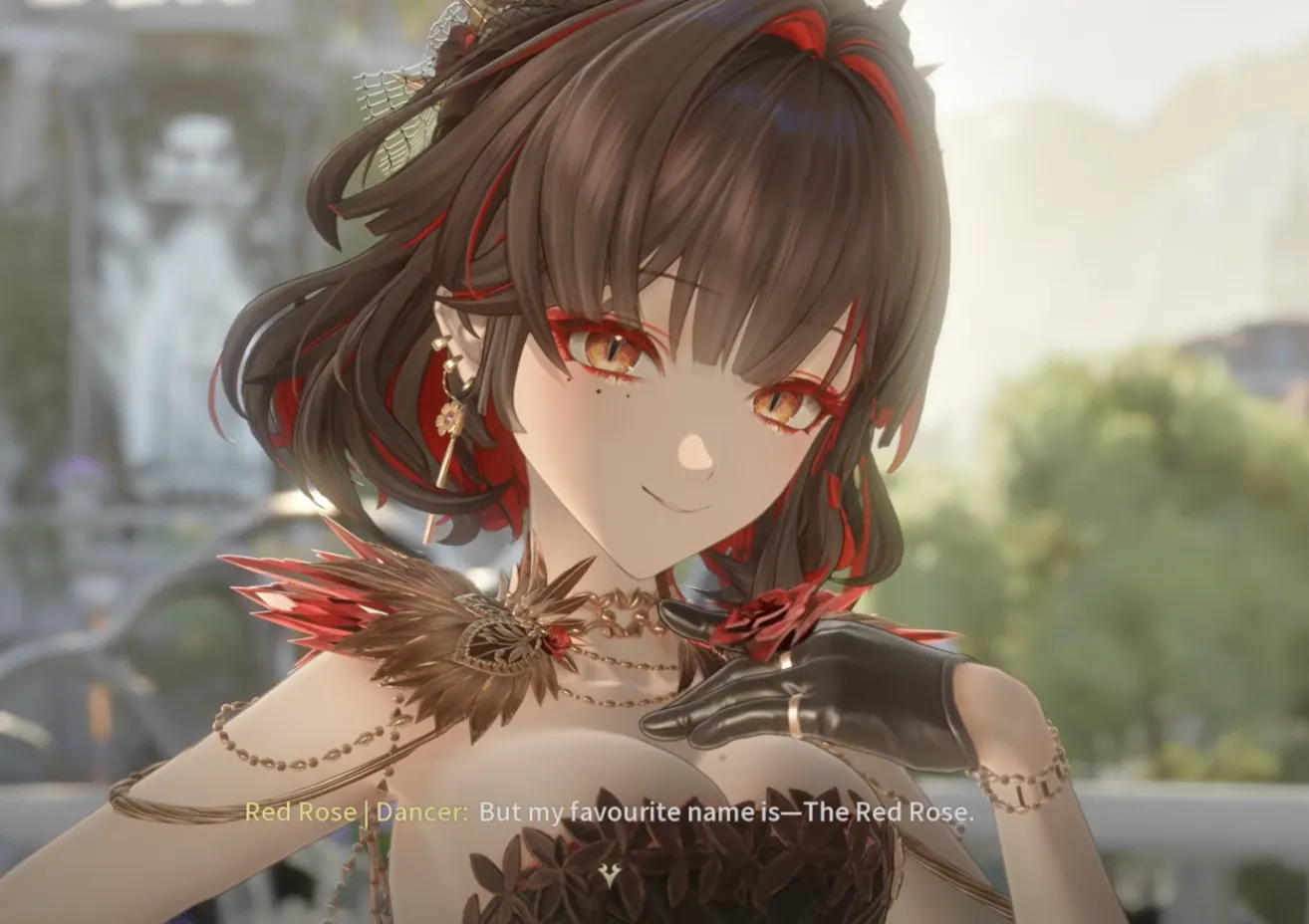
Thirty seconds into meeting the Detective, the Red Rose is asked who she is, and she answers three times. First with a list of names for a partnership he never agreed to: "Red and black, the Raven and the Rose, or A Study and Scarlet?" Then with a list of things she has been called: "a dancer, a star, finder of secrets, a solver of troubles, and more." Then with a preference: "But my favourite name is the Red Rose."
Three answers, none of them a name. It reads as flirting, and the scene plays it that way. But one of those three answers is the thing she has been working toward her entire life, and the game says so outright in a place most players never look.
The Ashley case works because Ashley leaves contradictions lying around. The Red Rose leaves nothing lying around, and she is proud of it. So her case has to be built somewhere else: out of her combat barks, her preferred gifts, the flavour text on her signature motive, and the two Shakespeare sonnets she cannot stop quoting. Work those and she turns out to be the least mysterious character in the cast. She just never says any of it while anyone is listening.
The applicant who was never an applicant
Chief Inspector Lorin has spent the morning shortlisting assistants and is pleased with his last one: "an experienced company clerk, 10 years of experience, totally literate, and no stranger to hard work. You won't find a problem with this one. He's waiting for you at the second floor office."
The person waiting in the second floor office is a woman in the clerk's clothes.
The account she gives is worth reading closely, because it is the only time she explains her own methods. "I wanted to move myself up in the queue, so I asked my dear competitor to swap places. The clerk will be all right. I just borrowed his clothes and followed their chief inspector to your place." Three operations in one sentence: she identified the shortlist, she got a stranger out of his appointment, and she tailed a serving police inspector across the city unnoticed.
Then she asks for the case. "I hear your return involves a major case from the constabulary. Why don't you let me in on this?"
The Detective is reading her the whole time, and what he reads is not an applicant. "A hidden miniature reactor made to look like an ornament. She's likely capable in a fight." "A gun belt beneath her skirt. She is armed and the weapon is always close to hand." "A razor sharp concealed weapon. She is literally armed to the teeth." A concealed Reactor disguised as jewellery, a thigh holster, and a blade, worn to a job interview.
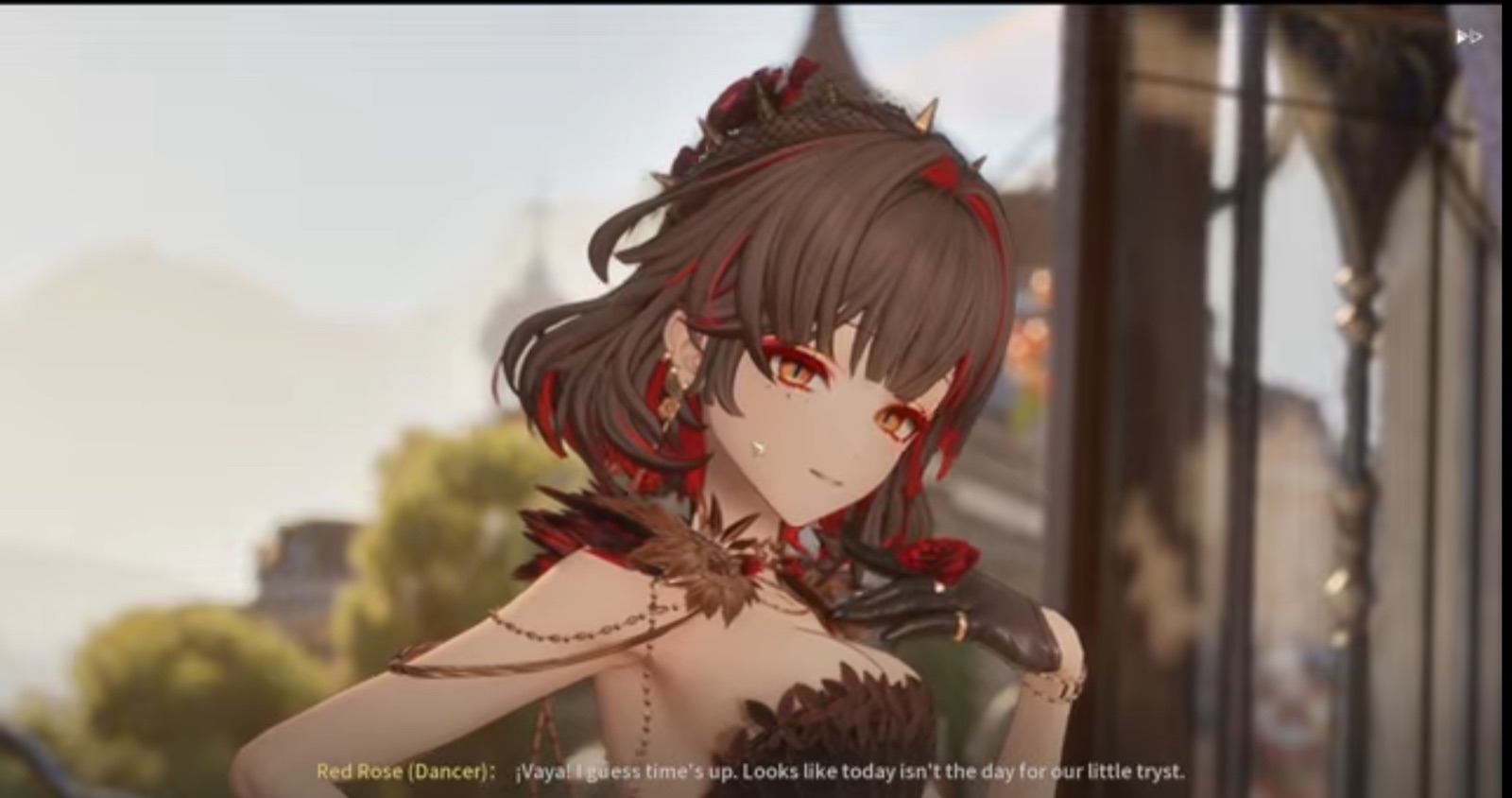
Lorin walks in, and she is gone before anyone can hold her: "¡Vaya! I guess time's up. Looks like today isn't the day for our little tryst. It doesn't matter. It was curiosity that brought me here. My goals have been fulfilled."
That last clause is the tell. She did not fail to get hired. She never applied. She came to look at him, she looked, and she left satisfied. Lorin's reaction is the honest one: "Can't believe it. My best candidate was an impostor."
There is a second consequence nobody in the scene notices. By burning the strongest candidate on the list, she cleared the way for the next one, and the next one was Ashley. Six hours of story later she confirms that removing the clerk was a paid job.
"Red and black" was never a joke
Her signature motive is called The Bloodbath Mystery, and its description is the single most important piece of writing about this character. It has nothing to do with combat:
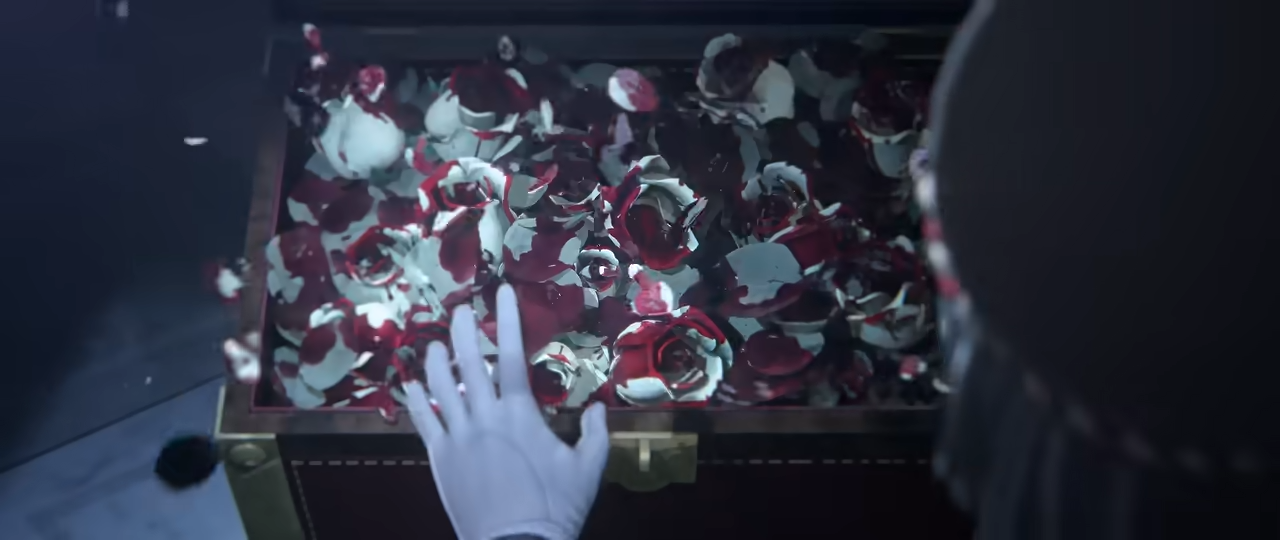
"The colour of the dresses worn by members of House Flora is strictly dictated by hierarchy. Children wear white, young maidens wear pink, and adulthood is marked in vibrant red. Yet there remains a secret known only to its innermost circles: beyond the esteemed red there lies a hidden echelon, that of black. Black represents their sins, the colour of dried, faded blood. Red Rose has waited and prepared for that day her entire life."
Read that against her introduction. Flora ranks its members by dress colour: white, then pink, then red, and above red, known only to the innermost circles, black. The first thing this woman ever says to the Detective is a partnership named "red and black."
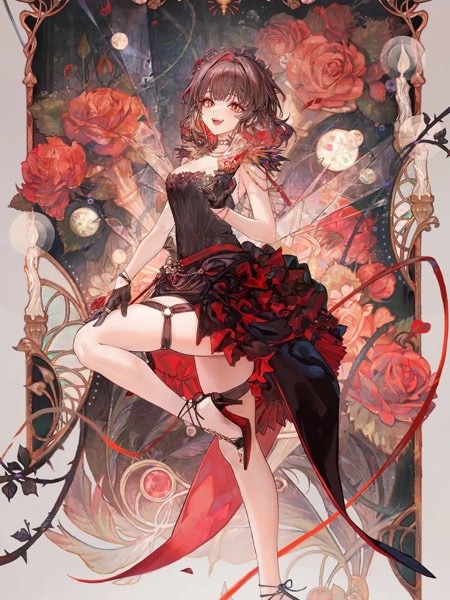
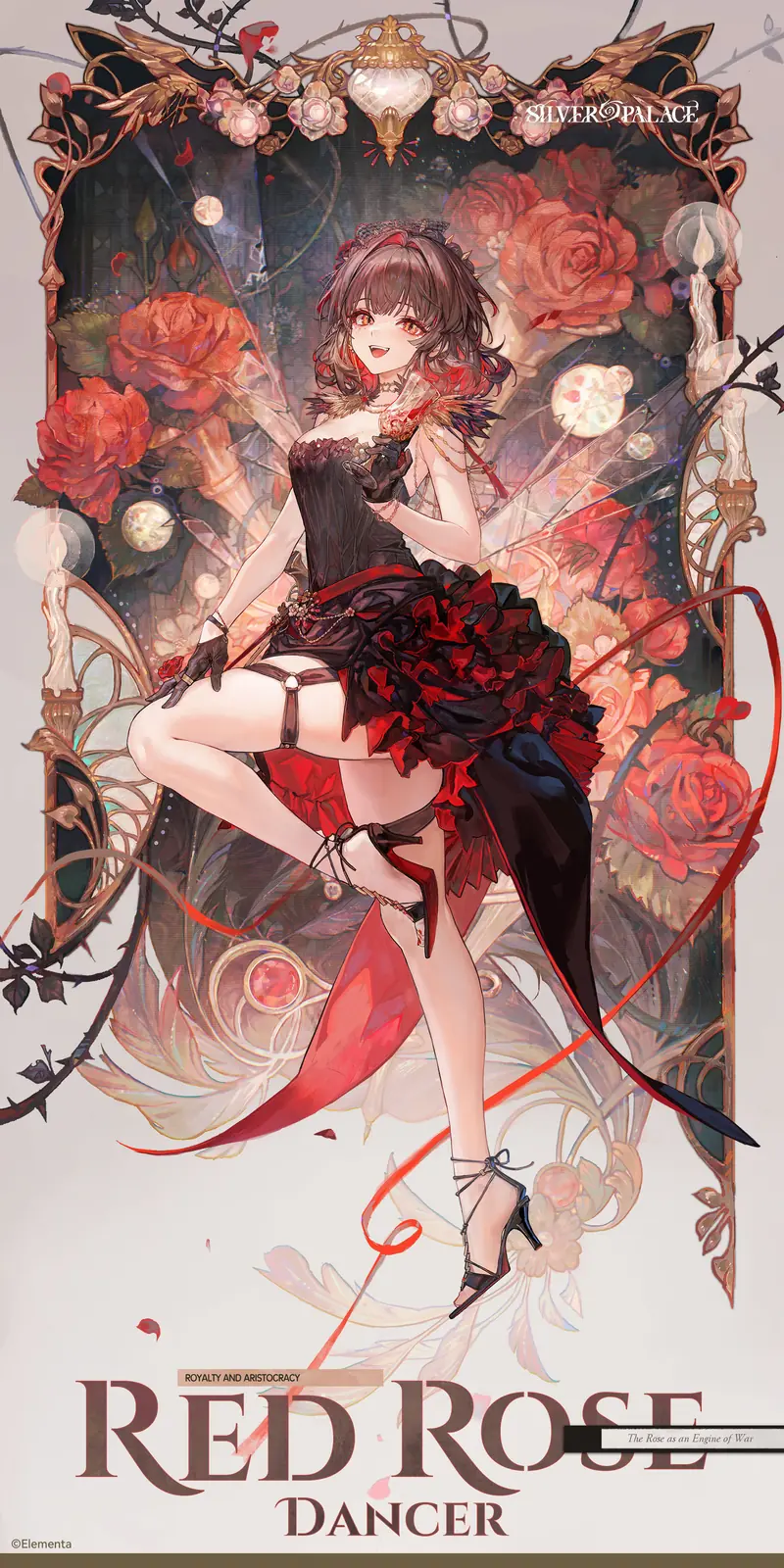
Look at what she is wearing while she says it. Her dress is black, boned and structured, with crimson detailing through the skirt and a red rose at the throat. She is not dressed in the red of Flora adulthood. She is dressed in both ranks at once, the one she holds and the one she wants, and she opened a conversation with a stranger by naming them in order.
The line lands as a literary joke, and it partly is one. "The Red and the Black" is Stendhal, "A Study in Scarlet" is the first Sherlock Holmes novel, and her first psyche node is named A Prelude in Scarlet. She talks in book titles. But "Red Rose has waited and prepared for that day her entire life" puts a floor under the joke. Whatever black costs inside House Flora, she has been paying toward it since she was one of the girls in white.
The house she never quite denies
At the ballroom, the Detective finally puts the question to her, and he builds the case properly. He starts with rank: "A noble of rank and influence." He justifies it: "Your attitude, your attire, that condescending demeanor. You make no effort to hide your. What's more, you do as you wish in a ballroom crowded with powerful elites, yet nobody bats an eye." Then he escalates: "No, your power is beyond most noble."
Then he names the house and the mechanism: "Rumors abound that House Flora grants flower related titles to its esteemed members. Titles like Red Rose." And he explains why Flora specifically: "Few noble families would shelter one as reckless and indulgent as you in their ranks, but Flora might."
He is right on every count, and he gets nothing. On which face is real: "They all are. Or perhaps none of them. Who's to say?" On her power: "Is that so? I am but a humble ship floating amid the storm they have unleashed." On Flora: "You seem quite knowledgeable in Flora's affairs." On the ballroom: "What you see is what you get, cariño."
Not one denial, not one confirmation. Note the pronoun in the second answer, though: the storm "they" have unleashed. Asked whether she is one of the great houses, she answers by placing herself outside them, and it is the only moment she takes a side at all.
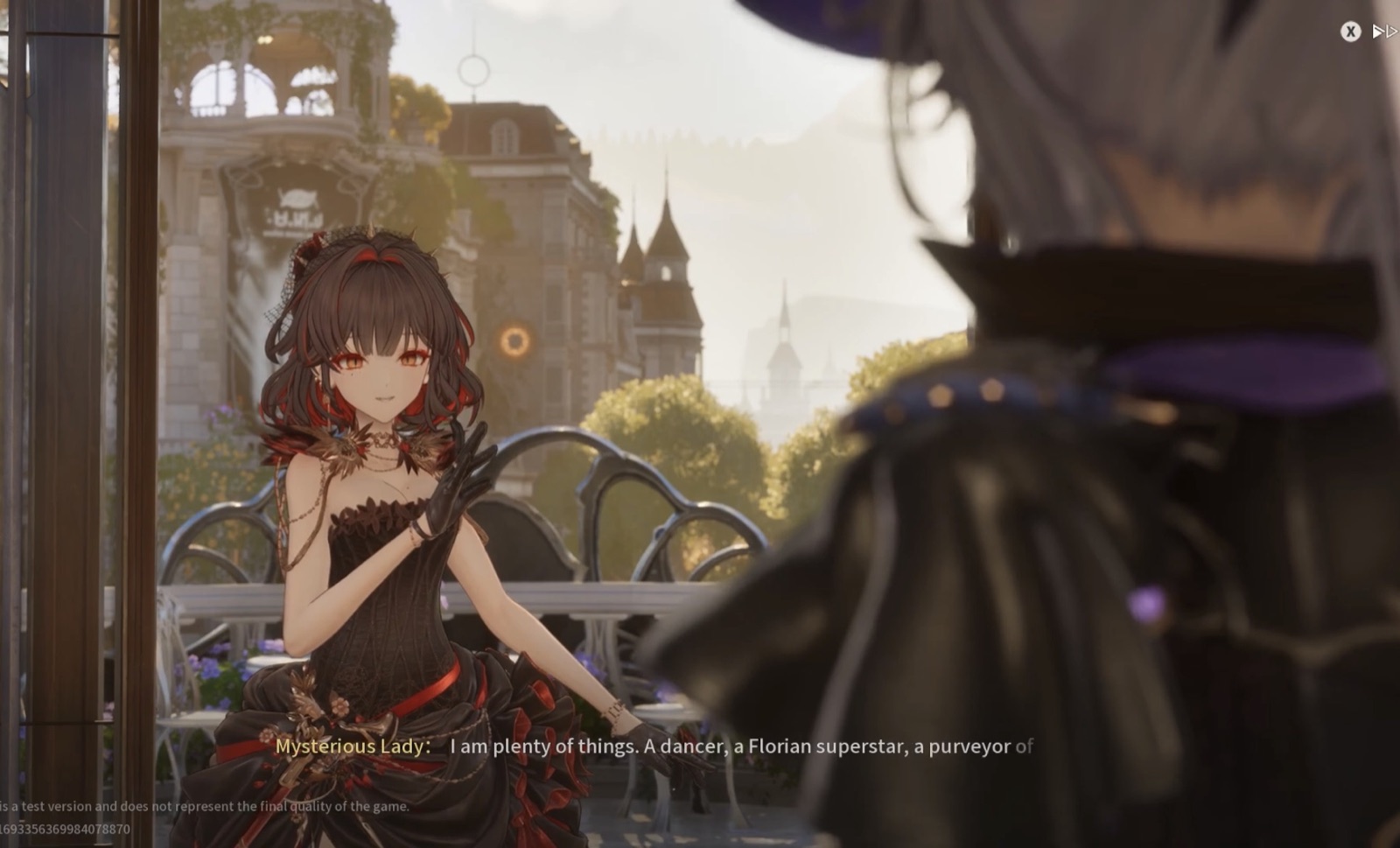
What makes the deflections readable is that she has, in another telling of that same first meeting, answered the question outright. Billed only as a "Mysterious Lady," she runs through the list she likes and one of the entries is not vague at all: "I am plenty of things. A dancer, a Florian superstar, a purveyor of..."
Florian. Not an associate of Flora, not a contractor, but the adjectival form, the way you would say a Silvernian. It is the one time she files herself under the house rather than deflecting the question, and it is the word our Florian Superstar piece took apart when it was still possible to read Floria as somewhere on a map rather than a family. The Bloodbath Mystery text settles that: Flora is a house inside Silvernia with a dress code, an innermost circle and a rank she is working toward, and Florian is what you call someone who belongs to it.
The rest of the answer is in the evidence rather than her mouth. House Flora's public power runs on colour: suede is fashionable "thanks to House Flora's relentless promotion," and Solferino, the dye and cosmetics house whose brochure turns up as a case document, makes the limited-edition lipstick that is one of her three preferred gifts. A family whose grip on the city is exercised through what colour things are, and whose internal ladder is also a colour. Of course her ambition is a colour.
The ballroom is not a place, it is a business
The Detective goes to the Midsummer Night's Ballroom on an invitation he calls "a hint left to me by a mysterious informant," and he cannot find her by looking. He works the floor and overhears three conversations, none of them hers. A circle around Mrs. Ramon gloating over a competitor's collapse: "Ready your wallet. Their stocks will plummet and we'll swoop." A pair arranging themselves around an heirless aristocrat: "He's a duke with a considerable inheritance. I'm the one who has to accompany him back." A woman confronting a man named Julio about a promised first dance.
Insider trading, an inheritance scam and a betrayal, in the first three tables he passes. That is not colour, it is the inventory of what the venue is for.
Her own explore line says the same thing from the inside: "I'm quite fond of these aristocrats. Their veins course with conspiracies, desires, and hysteria... They remind me that I'm not alone." Her intel entry calls her "Ruler of the Midsummer Night's Ballroom," and the only definition anyone offers is hers: "The Midsummer Night's Ballroom is what you wish it to be, what you want to gain from it."
Which answers what she actually sells. Not dances. Access, and what access produces. The one outside opinion the game records belongs to Gratia, a serving Royal Knight: "My senior knights warned me about the suspicious folk around here." The Crown's own knights brief their juniors about this ballroom before sending them in.
And in the game's own case files, the ballroom is a link in a chain rather than a setting. "Red Rose's Invitation" is a numbered evidence document, filed immediately after the Skea Private Hospital paperwork and immediately before the "Letter to Evan King" that the Ashley case turns on. The invitation is not a party favour. It is the piece of evidence that moves the investigation from the hospital to Bridgehead.
Sun against moon
Her profile lists two dislikes. The first, "non-romantics," is a joke she would make about herself. The second is not a joke at all: House Luna.
Nothing in the story explains it. Her voice lines explain all of it, because once you know to look, she is running a sustained campaign against the moon. Her Potential Break line: "When summer's breath their masked buds discloses, 'tis then I'm fated to outshine the moon." Her line for a sunny afternoon: "A flower would rather face the fiercest noon sun than endure the cold, cruel light of the moon..."
Her own official biography uses the same weapon against her. It describes her brilliance shining through a thorny exterior, and then: "Yet wan moonlight and noxious mists pervade, enshrouding her, and scarring her very soul." Moonlight is the thing that dims her and the thing that scars her, in the text the developers wrote to introduce her.
Her preferred gift completes the set: Hardy Foliage has "leaves that extend like the tips of the sun god's crown." Of everything in the gift shop, the plant she wants is the one shaped like a sun. Even her venue is solar, since midsummer is the year's longest day, and she rules a ballroom named for it while listing the moon's house as a thing she cannot stand.
House Luna is Cynthia II's house, the branch of the royal family closest to the throne, and the game has one more joke to make about it. Cynthia's casual conversation with the Detective includes this: "I don't have a partner for my ballroom dance lessons... Detective, do you want to help me out?" Luna's scion is taking dance lessons and cannot find a partner. The woman who owns the ballroom is on record disliking her house.
She only ever quotes two sonnets
She quotes Shakespeare constantly, and always the same two poems.
Sonnet 18 is the flattering one, and she aims it outward. On growing stronger: "Gracias, cariño. Thou art more lovely and more temperate than a summer's day." On her own inner feelings: "Such fair creation, time and again, undone by fate's changing course. Only thy eternal summer shall not fade." Both lift directly from the sonnet everyone knows, the one that promises the beloved will not fade.
Sonnet 54 is the other one, and she aims it at herself. Her Potential Break line borrows "when summer's breath their masked buds discloses." Her Scattered Thoughts line is blunter: "From canker'd soil was the beauteous shell built... They live unwoo'd and unrespected fade."
Sonnet 54 is specifically a poem about roses, and specifically about the wrong kind. It contrasts the true rose, whose scent outlives it, with the canker bloom: a flower with just as deep a colour and no perfume, which therefore dies unloved and unremembered. Shakespeare's term for a beautiful thing with nothing inside it is the term she reaches for about herself.
So she has divided the two poems by target. The immortality goes to the Detective. The canker bloom, grown from spoiled soil, admired by nobody, fading unrespected, is her own file on herself. Her character quote runs the same double structure: "Hidden 'neath the rosy skirt are white stems you adore... furnished with lethal thorns."
The literary layer is not decoration here, it is the layer she speaks in, which fits a game that names all thirty of its Epiphanies after real books. One of them is The Red Shoes, after the Andersen tale about a girl whose crimson shoes will not let her stop moving: "in those red dancing shoes, she danced out of the ballroom and onto the street, then into the murky forest depths." Its in-game buff is called Sanguine Step. Her official bio calls her "a dancer who never stops."
The Spanish nobody explains
She is the only character on the roster who code-switches, and she does it throughout the shipped English text. "¡Vaya!" leaving the office. "Gracias, cariño" on growing stronger. "We meet again, cariño" as a greeting. "Cariño, dance with me!" opening a fight. "Interesante" inspecting a clue. "Pobrecito" over a target. "A que no me das" while dodging. "Floreced" firing her Ultimate.
The game never explains it and no other character remarks on it, but the lines sort cleanly. Every one is either an endearment or a killing: cariño for the Detective, pobrecito for the man about to die, floreced for the moment the thorns go out. Affection and lethality are the only two registers she reaches for in her first language, which is exactly the pair her title page names.
The two things she says about curiosity
She makes two statements about curiosity, roughly eight hours of story apart, and they do not agree.
Leaving the Detective's office in Act I, having tailed a police inspector across the city and impersonated a stranger to get into the room: "It was curiosity that brought me here. My goals have been fulfilled."
At the ballroom in Act IV, asked why Ashley wanted the Detective protected: "Why? I never asked. In my line of work, curiosity kills the cat, as it were. She paid for my help, and the job happened to suit my taste. A fine deal is all it was."
Both cannot be professional policy. She has a rule against asking why, and she broke it for exactly one person, before she was paid anything, on nothing but interest. She does not ask about the client whose money she is taking. She crossed Silvernia in a stolen suit to ask about him.
The ballroom conversation catches her doing it again. After forty minutes of deflection she notices which way the questions have been running and says so: "Now that's more like it, detective. I was starting to think you'd never stop asking about me."
The recruiter, not the rescuer
The scene everyone remembers from her ballroom account is the rainy night in Bridgehead, where she finds a blood-soaked Ashley standing over her first kill and saves her from a group of thugs. It plays as a rescue. Her narration is not a rescue.
Watch what she is assessing. "She has just bloomed. Quite the scent of blood. Messy, clumsy work. Her first time. Not that it matters. Girls who can bloom all on their own become fine figures in the house of Flora." That is not sympathy, it is a scouting report, and it ends on the name of the house.
She keeps going in the same register. "Poor girl who plucked you out and cut you down, my little flower. Don't you worry. Soon you shall flourish in our soil, little one." Our soil. Not her soil, not the city's. When the thugs arrive she is annoyed at the interruption and possessive about the find: "Just bloomed and already attracting pests. How predictable. I have no qualms with being the knight in shining armour." Then, walking into them: "Gentlemen, I have found her first."
And she says out loud that this is a process she runs at volume. When Ashley responds to the recruitment pitch by asking for a contract killing instead, Red Rose is entertained precisely because it is unusual: "I've taken many in before, and no two react quite the same. But that's a first."
So the Bridgehead scene is a recruiter reaching a candidate before anyone else does, and the offer she leaves is a standing one: "If one day this line of work appeals to you or you get the money, come and find me here." What makes it land is that Ashley declines: "the poor girl looked for me time and again. Yet, things didn't pan out as I'd hoped, and she refused my invitation."
Ashley came back for years and never took the job. She bought piecework instead, which is why Red Rose keeps describing it in commercial terms ("A fine deal is all it was") and why Ashley's own intel entry, written from the other side, records only that "Ashley and Red Rose seem to have some kind of prior agreement." Two people who have known each other for years, and each one's file says the other is a contract.
One detail sits underneath all of it. Her preferred gifts include Hardy Foliage: "Sure to bloom even if left alone, needing only a little water to remain vibrant and verdant through the seasons." The thing she likes best is a plant that blooms without help, which is the exact quality she was grading Ashley on in the rain.
What she says when nobody is being charmed
Every answer she gives in conversation is managed. Her combat barks are not, and they are where the character is kept.
Firing her skill, she says: "Not enough... it's NEVER enough!"
Set that beside her motive text: she "has waited and prepared for that day her entire life." A woman with one lifelong objective, whose involuntary line mid-fight is that nothing is ever enough. Nothing else she says all game is that unguarded.
The rest of the set keeps confessing. On victory: "Stripped of thorns, beauty is a sin in itself." Her house's hidden rank is black, and black, per the same motive text, "represents their sins." She has a theory about what beauty without defences amounts to, and it is the word her own family uses for its top tier.
Wounded, she escalates rather than retreats: "The closer to death, the brighter I bloom!" Run to exhaustion, the performance finally drops: "I only wanted... to bloom for you... just a little longer..."
For you. Not for Flora, not for the black. At the point of collapse the objective she names is a person, and the woman who calls identity "a boring construct" and clients "a fine deal" turns out to have been dancing for somebody.
Her executions are colder than any of it. "Your role ends here" is stage direction, and "New source of nutrients" is what a rose says about a body.
The view from outside matches. A five-star implement set named Flora and Fate, pairing her house with the word her title page uses for her sentence ("the hand given to her by fate is dark and cruel"), carries a witness statement: "Following the death, I witnessed a faint yet entrancing figure flitting past the window. As if drinking in the night and its still silence, the dim light and... and the terror."
Entrancing, and then the terror. Somebody who saw her work could not finish the sentence.
What her kit is called
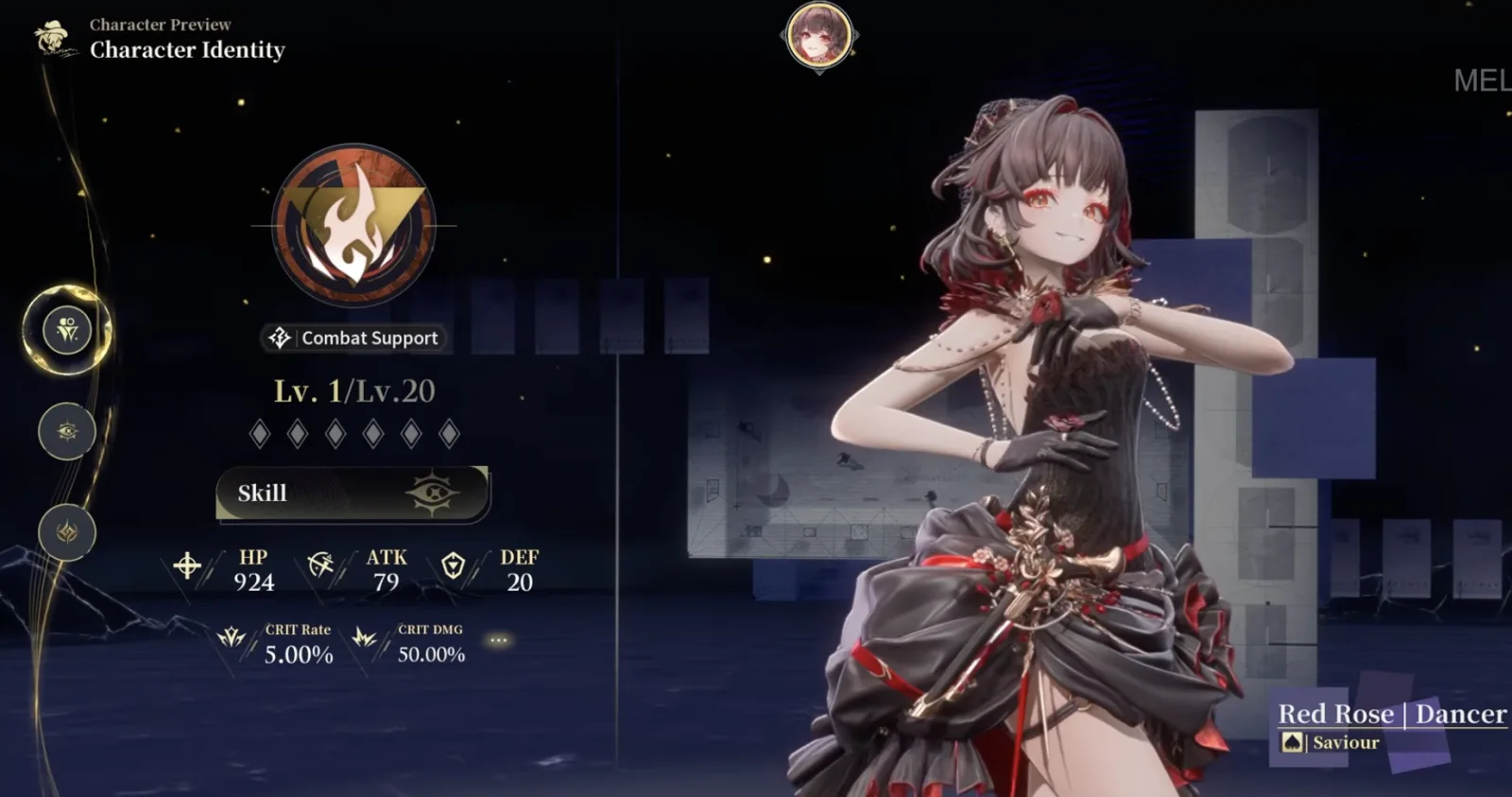
Her whole kit is one continuous performance, in order. Onstage Preparation is her passive, Epic Debut her switch-in, Akimbo Overture her basic attack, A Prelude in Scarlet her first psyche node, War of the Roses her skill, Grand Finale her Ultimate, A Blooming Finale her last node. Preparation, entrance, overture, prelude, the war, the finale. The mechanics are covered in the Red Rose kit reveal; what matters here is that someone named every node after a stage of a show.
Two names break the pattern, and they break it together. Her fourth psyche node is Love's Affliction. Her fifth is Death's Malediction. Love and death, side by side, in the only two names that step outside the theatre, on the character whose title page ends: "Only in love or in death shall she be granted forgiveness."
Then there is her Identity. She is filed as a Saviour: "One who possesses the wisdom to defy death, betray a predetermined fate, and bear the price that follows." Read that against the woman in the rain saying "I have no qualms with being the knight in shining armour," and against a fate written in dress colours before she was old enough to choose one. Identity is not a combat role, and in her case it is the closest thing to a thesis anyone has written down. A predetermined fate, betrayed, at a price.
The investment
She keeps her promise to Ashley, tells the Detective everything she was asked to tell him, and then does three things she was not paid for.
She hands over a tool: "And this is a single use skeleton key. No need to thank me. Consider it a reward for that splendid death." She gives him a warning that has nothing to do with the contract: "It's not just anyone who's after your head, detective. Most never tread waters this deep. And the currents only get deeper. So be prepared if you value your life." And she vouches for her own client against her own interest: "Regardless of her true intentions, that girl cares for you. So, don't let her down."
Then she prices it. "Consider this an investment. I hope my judgment is right. Perhaps one day I shall need your aid. But in completing which task, I wonder."
An investment, from the woman who says she never asks why, in the one man in Silvernia licensed to go into rooms she cannot enter as herself. She has spent the whole case being paid to keep him alive by a client who is about to walk away, and her closing move is to convert that arrangement into a debt he owes her personally, for a job she has not named.
Her relationship track names the destination. The three levels of the Detective's standing with her run: Pleasant Surprise, then Soulmate Dance Partner, then Perfect Accomplice. Not partner, which is the word she offered him in Act I. Accomplice, which requires a crime.
Verdict: who Red Rose really is
Put it together and she is not a freelance killer who happens to move in noble circles. She is the opposite: a daughter of a great house who has built a killing business as the instrument.
House Flora raised her inside a ladder made of dress colours, white to pink to red, with a black tier at the top that the house reserves for its own sins. She has been working toward that tier her entire life, and she introduced herself to a stranger by naming it. She runs the Midsummer Night's Ballroom, which is not a venue but a market in access, insulated well enough that Royal Knights brief their juniors about it and nobody in the room objects when she does as she likes. She recruits, at volume, from girls who have already killed someone unaided. She keeps a rule against asking clients why, and the one time she broke her own rules for free was to look at a detective.
Inference and text should stay separate. The Bloodbath Mystery text is unambiguous about the Flora hierarchy and about her lifelong preparation. What she never does is confirm any of it on screen: no real name, no rank, no employer, only deflections. And the thread that would explain the rest stays a thread. Her first-meeting line is "The curtain falls; thus have I come to thee. Long parted, how brief shall our meeting be?" At the ballroom, watching him work, she stops herself: "It's just that serious gleam in your eyes as you state your case. It reminds me of something." Long parted. Reminds me of something. Neither gets finished, and she does not appear again after she walks him to the door.
The most revealing thing she says all game is not spoken to anyone. It comes out mid-fight, from a woman who has spent her whole life preparing for one day: "Not enough... it's NEVER enough!" Everything else is a performance about a rose. That one is the canker bloom talking, in Sonnet 54's own terms, about the beautiful thing with nothing inside it that fades unrespected.
She has one day she is waiting for and one person she was blooming for, and by the end of the case she has converted the second into a claim on a task she declines to name. "Perhaps one day I shall need your aid." That sentence is the whole character, and nothing in the story so far pays it off.
FAQ
Who is Red Rose in Silver Palace, really?
A 5-star Ignis Combat Support with the Saviour Identity: a dancer who rules the Midsummer Night's Ballroom and runs an assassination business. The evidence points to her being a member of House Flora rather than an outside agent, since her signature motive describes Flora's dress-colour hierarchy and says she has spent her whole life preparing to reach its hidden black tier. She never confirms it on screen.
Is Red Rose a member of House Flora or just working for them?
The Bloodbath Mystery motive text describes her from inside the hierarchy, laying out the dress ladder (white for children, pink for maidens, red for adulthood) and then saying she has waited and prepared her entire life for the hidden black rank. She has also called herself "a Florian superstar" outright, which is the one time she files herself under the house instead of deflecting the Detective's Flora questions.
What is the black echelon in House Flora?
Per her motive description, a tier above red known only to Flora's innermost circles. Black stands for the house's sins, described as the colour of dried, faded blood. Her victory line, "Stripped of thorns, beauty is a sin in itself," uses the same vocabulary. What reaching black requires is never stated.
Why does Red Rose dislike House Luna?
The story never says, but her voice lines are consistently anti-moon. Her Potential Break line has her "fated to outshine the moon," and her sunny-afternoon line prefers "the fiercest noon sun" to "the cold, cruel light of the moon." Her bio has moonlight scarring her soul, her preferred gift is a plant shaped like the sun god's crown, and her ballroom is named for the year's longest day. House Luna is Cynthia II's house.
Did Red Rose save Ashley or recruit her?
Her own narration reads as recruitment. She assesses Ashley as a prospect ("Girls who can bloom all on their own become fine figures in the house of Flora"), talks about her flourishing "in our soil," tells the thugs "I have found her first," and notes that she has "taken many in before." Ashley refused the invitation and paid for individual jobs instead.
Why does Red Rose speak Spanish?
The game never explains it, and she is the only character on the roster who does. Six phrases appear in the shipped English script, including "¡Vaya!", "Gracias, cariño," "Interesante," "Pobrecito" and "Floreced." Every one is either an endearment or tied to a kill, mirroring her title page's line about being forgiven only in love or in death.
What does the Saviour Identity mean for Red Rose?
Identity is separate from Combat Style and Reactor Attribute. Saviour is defined as "One who possesses the wisdom to defy death, betray a predetermined fate, and bear the price that follows." Read against a motive text about a fate assigned in dress colours before she could choose one, it is the closest thing to a stated thesis for the character.
What is the Midsummer Night's Ballroom?
A noble ballroom in the boutique quarter that she rules. The only definition offered is hers: "what you wish it to be, what you want to gain from it." The conversations the Detective overhears there are insider trading, an inheritance scam and a betrayal, and Gratia relays that senior Royal Knights warn juniors about the people in it.
Does Red Rose appear again after the ballroom?
Not in the story so far. She gives the Detective a single-use skeleton key, warns him the currents get deeper, tells him not to let Ashley down, and calls the exchange an investment against a favour she may call in later. The story ends without naming that favour.
Know someone tracking Silver Palace? Send them this.
About the Author
Silver Palace Meta Team
Silver Palace Meta Team
We're dedicated to providing comprehensive coverage of Silver Palace news, updates, and community insights.