Silver Palace Investigation and Deduction Guide

Silver Palace splits detective work into two halves that barely resemble each other. Out in the city you gather, and the game is patient about it. You can turn a bloodstained shoe over in your hands until the last clue on it is ticked off. At the Evidence Board that patience ends, because the Board is where the game asks you to be right.
This guide covers the gathering tools by their in-game names, the Board they feed, and the two field mechanics that fire while you are walking between them.
The short version
Four tools collect information. Eye of Insight reads people. Body Forensics reads corpses. Crime Scene Investigation reads objects. Gathering Intel reads overheard conversation. Everything they turn up lands in a case's Evidence Repository, and you spend it at the Evidence Board, slotting pieces into evidence chains until each chain yields a hypothesis and the last chain yields the Final Hypothesis.
Two other mechanics run in the open city. Suspicious Activity is how you find enemies wearing a disguise. Infiltration is how you get past guards who would rather you did not.
Four ways to gather
The four tools share a shape. You enter an examination, the game marks what can be examined, and a counter tracks how much of it you have found. What differs is the target and the verb.
Eye of Insight
Eye of Insight is the people-reading tool. You move the camera to observe a target and gather characteristic data from them, then select an observable area to pull information out of it.

Note what the markers sit on in that frame. Not her face. A brooch and a pair of hands. The tool is looking for what a person is carrying and what they have been doing, which is a more interesting design choice than a generic scan pulse would have been.
Body Forensics
On a body, you select Investigate to examine it in detail, choose an examinable area, and collect the clues left there. When every clue is collected, the investigation closes.
There is a second body-examination sequence in the game and the site covers it separately. The surgery and autopsy minigame has you picking surgical instruments off a tray and working X-ray marked target points on a body model, shown in official Dichotomy footage. Body Forensics as the tutorial describes it is the clue-collection layer, with examinable areas and a completion counter. The two clearly belong to the same part of the game. Nothing in either source says whether they are one activity described at two zoom levels or two stages of a procedure, so this guide will not claim either.
Crime Scene Investigation
Scenes work like bodies with one addition. You select Investigate, pick an item out of the scene to examine closely, and then rotate it to different angles to find clues left on it. Complete the set and the investigation ends.
The rotation step is the one that earns the mode its screen time. A clue can be on the underside of a thing, which means the scene rewards handling objects rather than sweeping a cursor over them.
Gathering Intel
Gathering Intel is the quietest of the four and probably the one players will use most. Use Inspect on specific pedestrians to listen in on their conversations, and you will occasionally pick up something useful. Inspect an object instead and you get its detailed information.
That "occasionally" is the game's own word. Eavesdropping is a lottery, so the city is worth walking through slowly rather than mounting up and skipping past it.
The Evidence Board
The Board is reached from the Evidence Board in the Detective's Office or straight from the main menu, and it opens on Case Overview. From there you browse the cases you have unlocked and pick one.
A case's Board is built from evidence nodes and hypothesis nodes. The Evidence Repository at the bottom right holds every piece of evidence you have gathered for that case, and the Board starts mostly empty, waiting for you to fill it.
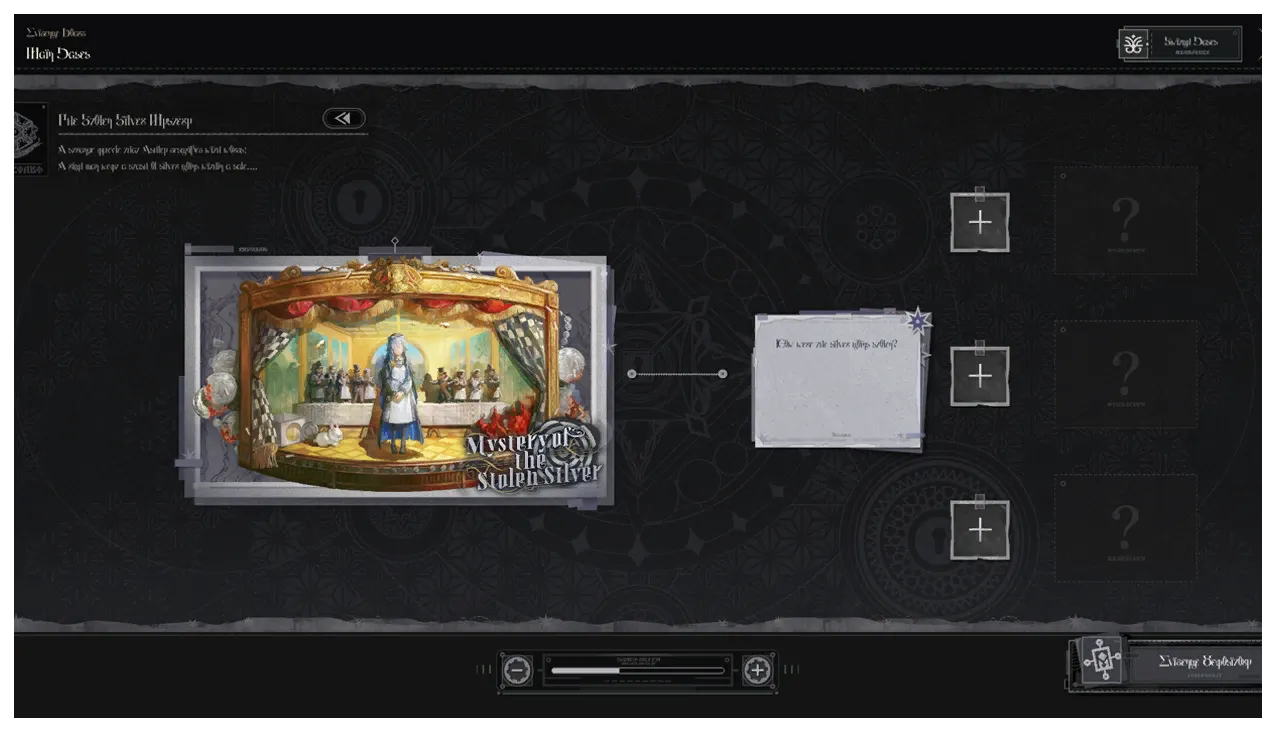
The layout in that frame is the whole system in one screen. Case art on the left with a note branching off it, a column of empty slots waiting for evidence, and three hypothesis panels still showing question marks. The case pictured is Mystery of the Stolen Silver.
Filling it works like this. Pick an empty evidence slot, or open the Repository, and move a piece from the Evidence List into the slot. The game then checks it against the deductive logic of that chain. Correct evidence locks into the slot. Wrong evidence goes back to the Repository.
That single rule is the most important thing to understand about the Board, because it tells you the cost of guessing is nothing. Nothing breaks. Nothing is consumed. A wrong piece goes back to the pile. The Board is a logic puzzle with free retries, and anyone who has lost an Ace Attorney trial to a penalty bar will feel the difference.
Place every piece in an evidence chain and the game awards you a hypothesis. Complete every chain in the case and it awards the Final Hypothesis, which closes the Board.
Out in the city
Two mechanics run while you are between cases, and neither is traversal, so they are covered here rather than in the movement and exploration guide.
Suspicious Activity
Some enemies in Silvernia are dressed as ordinary people. The Danger Radar is how you know they are there. It shows the direction of hidden enemies nearby, and when one is right next to you it flashes hard.
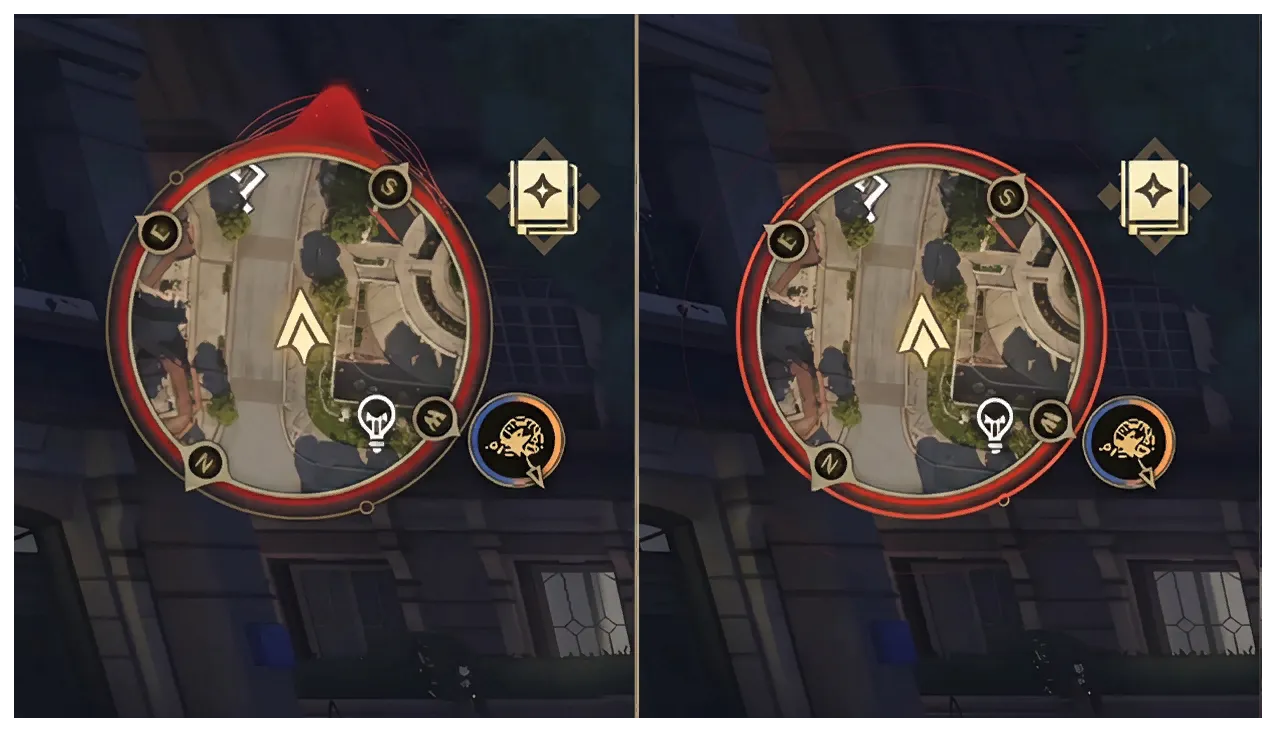
Both states are in that frame. A cone pointing at the threat on the left, the full ring alight on the right.
Finding the direction is not the same as finding the person. Hold the right mouse button on a passerby in front of you to observe them, or the left trigger on a gamepad. Once you have seen through the disguise and verified their identity, press the left mouse button, or the right trigger, to expose them and drop into battle.
Those bindings are worth flagging against the controls and keybinds guide, which has the right mouse button on guard and parry and describes investigation prompts as sharing the interact button. For this particular flow the game names the triggers directly.
Infiltration
Infiltration is about guards, patrolling or standing still, each with a detection zone drawn around them. Step into one and an Alert meter starts filling. Get closer and it fills faster. Max it out and you have blown the infiltration.
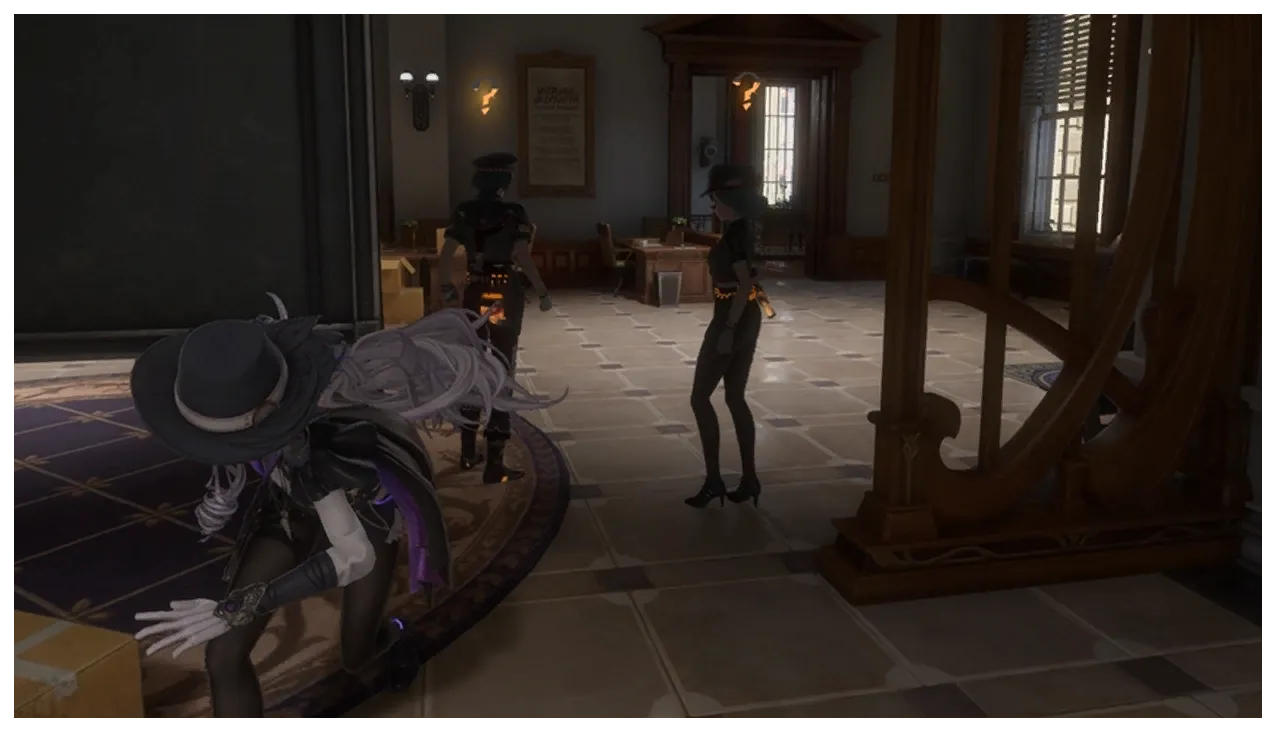
Hiding areas are the counterplay. Take cover in one and you are concealed, and you can stay there or move through it without being detected. Note that the meter fills rather than trips, so being spotted is a matter of degree and a bad line can be corrected if you break away early enough.
Curious Deductions, and being allowed to be wrong
Curious Deductions is the mode built on top of the Board, and its selling point is that a case can end more than one way. Elementa's own description of The Resurrection Enigma puts it plainly: every deduction you make shapes the investigation and leads the mystery toward a different conclusion.
You can keep deducing until you reach an answer you are happy with, then hit Restart Deduction to roll back the Board's progress and chase a different ending. Only one of them is the truth, and finding it awards a collectable and an achievement.
The site has a full breakdown of that case and its endings in the Curious Deductions guide, including the beta build's Howard Williams case at Williams Manor.
What casework pays
Four achievements sit under Curious Deductions in the Hero's Journey category, paying 50 Reactor Crystals between them.
| Achievement | Goal | Medal | Reactor Crystals |
|---|---|---|---|
| Midnight Echoes | Complete "The Resurrection Enigma". | Bronze | 10 |
| The Game Is Afoot | Achieve any ending for the first time. | Bronze | 10 |
| The Truth Will Out | Achieve the true ending of "The Resurrection Enigma". | Silver | 20 |
| Enigmatic Return | Use "Restart Deduction" for the first time. | Bronze | 10 |
Enigmatic Return is the one to notice. The game pays you ten crystals for using Restart Deduction once, which is a design team telling you outright that replaying a case to a different ending is intended rather than tolerated.
How the pieces fit together
Investigation is the gathering half of a longer loop. The four tools fill a Repository, the Board turns that Repository into hypotheses, and interrogations are where you take what you have concluded to a suspect and read them on a trait chart. Field work, then desk work, then the confrontation.
Frequently Asked Questions
What are the investigation tools in Silver Palace?
Four of them. Eye of Insight observes people and gathers characteristic data from them. Body Forensics examines bodies for clues. Crime Scene Investigation examines objects at a scene, including rotating them to check for clues on hidden faces. Gathering Intel uses Inspect on pedestrians to listen in on conversations, and on objects to read their details.
How does the Evidence Board work in Silver Palace?
You reach it from the Evidence Board in the Detective's Office or from the main menu, which opens Case Overview. Each case's board holds evidence nodes and hypothesis nodes. You move evidence from the Evidence List or the Evidence Repository into an empty evidence slot, and the game checks it against that chain's deductive logic. Correct evidence locks in place and wrong evidence returns to the Repository. Completing a chain awards a hypothesis, and completing every chain awards the Final Hypothesis.
Is there a penalty for placing the wrong evidence?
No. Wrong evidence returns to the Evidence Repository and you can try again. Nothing is consumed and no progress is lost, so the Board rewards experimenting rather than punishing it.
What is the Danger Radar in Silver Palace?
A readout that shows the direction of hidden enemies near you, and flashes intensely when one is in your immediate vicinity. It appears during Suspicious Activity, where enemies are disguised as ordinary passersby.
How do you expose a disguised enemy?
Hold the right mouse button on a passerby in front of you to observe them, or the left trigger on a gamepad. After you have seen through the disguise and verified their identity, press the left mouse button, or the right trigger, to expose them and enter battle.
How does Infiltration work in Silver Palace?
Guards patrol or stand idle, each with a detection zone around them. Entering that zone fills an Alert meter, and it fills faster the closer you get. Filling it completely compromises the infiltration. Hiding areas let you conceal yourself, and you can stay in one or pass through it without being detected.
What is the difference between investigation and interrogation?
Investigation gathers information and turns it into hypotheses at the Evidence Board. Interrogation is the questioning phase that comes after, built on a five-axis trait chart and five response options. The interrogation guide covers that side in full.
Can you replay a case to get a different ending?
Yes, in Curious Deductions. Restart Deduction rolls back your Evidence Board progress on that case so you can pursue a different conclusion. There is one true ending per case, and reaching it awards a collectable and an achievement. Using Restart Deduction once is itself an achievement worth 10 Reactor Crystals.
Sources
- In-game tutorial text for Eye of Insight, Body Forensics, Crime Scene Investigation, Gathering Intel, Evidence Board, Suspicious Activity and Infiltration, with the accompanying interface frames.
- Achievement data for the Curious Deductions group, including goals, medal tiers and Reactor Crystal rewards.
- The Science of All Things: Curious Deductions Edition, Elementa Games, 26 July 2026.
Know someone tracking Silver Palace? Send them this.
About the Author
Silver Palace Meta Team
Silver Palace Meta Team
We're dedicated to providing comprehensive coverage of Silver Palace news, updates, and community insights.